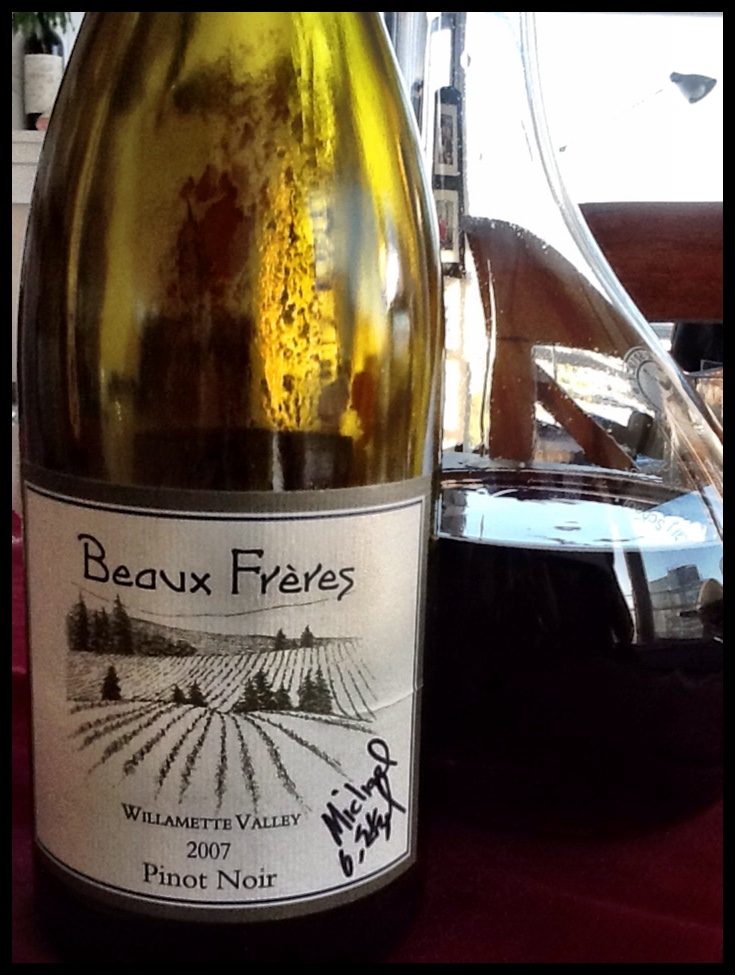
Beaux Frères, Pinot Noir, Newberg, Willamette Valley, Oregon, US, 2007, 13.8% abv.

BFreresIn March 2013, we visited this winery but managed to hold onto the bottle until a special birthday happened in 2015.  Read here for details and pictures from the morning spent tasting Beaux Frères wines in Newberg with wine guide, Anna and winemaker, Michael Etzel.

This is the bottle of their 2007 vintage we purchased.  A dark horse of a year, it had high acidity to help with ageing.

Upon opening it in August 2015, it showed medium minus garnet, a hint of ruby and evenly spaced legs.

The aromas are deep and layered with ripe bing cherry, red plum and forest floor, soft green moss and cedar.

The palate is dry with medium plus – almost high – acidity.  The tannins are scraped thin and absolutely gorgeous as they literally float over the tongue.  Alcohol is unobtrusive and the body is an elegant medium at the most.

Flavours show deep complexity with dried and ripe cherries, red and purple plum, truffle oil, cedar frond and nutmeg.  The finish is extended on this WSET Outstanding wine.

Unfined and unfiltered, this wine is produced from grapes grown on several different biodynamically farmed vineyards – Beaux Frères (30), Shea (20, Upper Terrace (16), Zena Crown (15), Amalie Robert (14) and the remainder from Carabella (5).  The fruit is still fresh and the acidity high which suggest it could age for 2-3 more years yet.

As Anna told us when we visited, ‘There are no insipid wines here’.

Posted in Oregon, Pinot Noir, RED | Tagged , , , , , , , , , , , , , | Leave a comment

Cabernet Sauvignon, Francis Ford Coppola, Director’s Cut, Alexander Valley, Sonoma Coast, California, 2010, 13.5% abv.

ffcoppola 1Francis Ford Coppola’s Director’s Cut line is said to be made in the image that most closely resembles the Director’s vision of a film.  The label itself is a reminder of that, made in the style of a zoetrope strip, an animation device that predates film.

Visiting this winery is like going to an adult version of Disneyland – and it is sure to keep any non-drinkers and children you’re towing about with you fully engaged.

Translucent ruby red with even legs, the nose shows blackberry, field berry, cassis and young vine with black pepper and a purple floral perfume.

The palate is dry with better than average acidity and medium alcohol.  The tannins are svelte and velvety and flavours show sweet boysenberry, ripe blackberry, more cassis, clove and nutmeg, thick green field grass, tobacco and vanilla pod.  The finish is satisfying and the body medium and elegant.

Purchased at the winery in Alexander Valley, this wine is WSET Very Good.  It’s drinking now, but do not hold any longer.  It’s at the end of its window on life.

Posted in Cabernet Sauvignon / Blends, California, RED | Tagged , , , , | 2 Comments

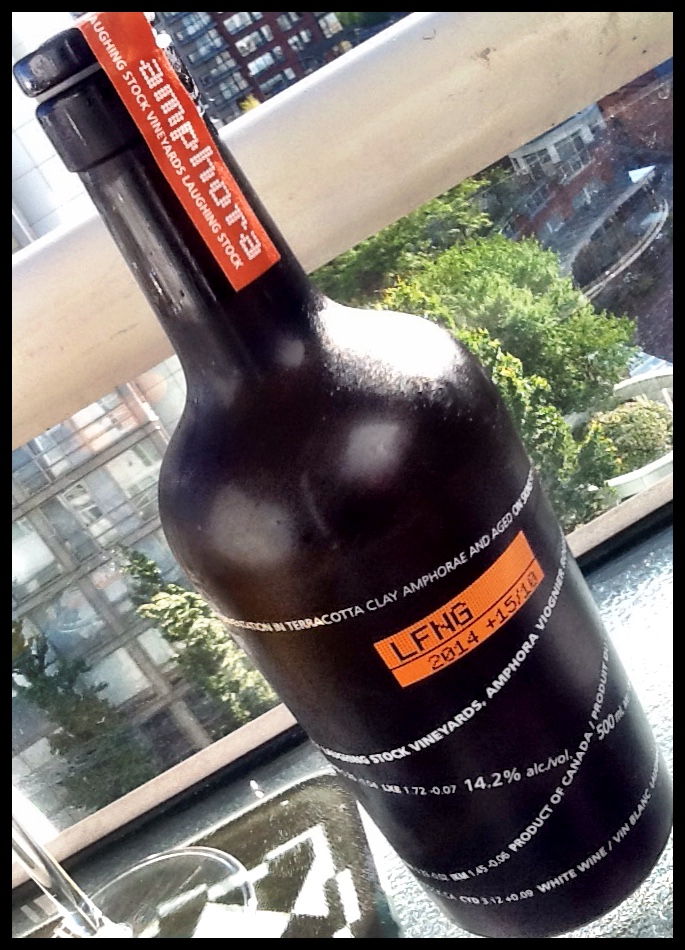
Amphora Viognier-Rousanne, Laughing Stock Vineyards, Naramata Bench, Okanagan Valley, BC, 2014, 14.2% abv. C$24, 500 ml.

laughing orange 2 When my certified expert in Italian wine friend called me to share a bottle of a made-in-BC wine using amphorae from Chianti, there was no hesitation on my part.

Medium gold with a fleshy peach overtone and deep legs, the grapes for this wine spent 2.5 months on the skins to attain this gorgeous hue.

The nose is all peaches and apricots with slight honeysuckle and almond.  There is an earthen quality that pervades as well – almost akin to Dogwood tree.  Now that’s how to make your BC amphorae wine take on a BC twist.

The palate is dry but the luscious fruit tricks your palate ever so slightly.  A medium acidity and pleasingly plump body envelop the flavours which show more orchard stone fruit, a floral element and a bitter almond – citrus rind kick on the back end with fresh earth and a waxy texture reminiscent of clay.

Marta paired this expertly with dried Turkish apricots, young manchego (which added some fat to the mouth to enhance the acidity, but didn’t detract from the wine), almonds and soft Laughing OrangeCalimyrna figs.

Only 150 cases of this WSET Very Good wine were made and it sold out quickly.  Note to self; must become a Laughing Stock Winery wine member to buy more next time around.

Posted in British Columbia, OTHER, Rousanne, Viognier | Tagged , , , , , , , , , | Leave a comment

La Cave d’Augustin Florent, Tannat, Madiran AOC, Southwest France, 2012, 13.5% abv.

This wine surprised me.  Being from Madiran AOC (which is located in South West France in the Pyrénées Mountains on the border with Spain) I anticipated it would be very concentrated and tannic. Madiran

Wines from Madiran AOC may only be red (there’s a sweet and dry white AOC too which covers the same area of production, but they’re produced under a different name – Pacherenc du Vic-Bilh.  Try saying that 10x in a row.  Was anyone in the marketing department thinking?).

Ah, but I digress… About 60% of a Madiran blend is supposed to be Tannat and it’s supported by Cabernet Franc, Cabernet Sauvignon and Fer Servadou (aka Braucol).  Some of the wines are actually 100% Tannat though, despite the rule.  Tannat, you may know, is also the main grape of Uruguayan wines, having been transported there by French immigrants from this region.

A beautiful shade of medium ruby, this wine has medium plus aromas of deep, black fruit with a little nutmeg.

On the palate, it’s dry with surprising medium plus acidity and ripe but strained tannins.  The body is equally surprising in that it’s slender; not what I’d anticipated.  Flavours show deep cassis and black plum with black and raspberry, nutmeg and a little dash of sage.

The finish is light and the alcohol a little hot, but overall this has some nice flavour and aroma notes.  It’s tasty, but don’t age it – enjoy with charcuterie.

WSET Good

Posted in France, RED, Tannat | Tagged , , , , , , | Leave a comment

Domaine Huet, Clos du Bourg, Moelleux, Première Trie, Vouvray AC, Loire, France, 2002, 12.5% abv, US$ 45 (half bottle)

Chenin Blanc is one of the most versatile grapes.  This wine is a botrytised, sweet version from Domaine Huet located in Vouvray, Loire Valley, France.

If you actually knew what these grapes look like when picked, you may not want to try the wine.  In addition to being botrytised, this is a first pass (trie) wine – meaning the grapes, affected by botrytis (aka noble rot), were hand-selected on the first pass through the biodynamically farmed Clos du Bourg vineyard.

clos du bourgSome drinkers are emphatically opposed to wines like this (without tasting or reading about them) because they’re sweet.  That’s just a shame though; this is a benchmark wine of the world – and something worth trying.  Paired appropriately, it will blow your mind.

The sheer amount of time and effort that goes into the making a wine like this, should alone convince you to at least try it.  They are among the best wine deals on the planet.  These grapes are picked individually – one by one – at exactly the right moment.  The time taken, the effort made…the work involved is enormous.

Deep gold with surprisingly delicate legs, the Clos du Bourg 2002 has sweetly honeyed and barnyard aromas of straw, game and ripe red apples.  It couldn’t possibly be anything other than a Loire Valley Chenin Blanc with that nose.

The palate is fully sweet with contrasting high acidity.  Flavours show quince, more sweet, red apple, game and honeyed biscuit.  There’s a long finish to compliment it.  I had hoped for sharper and more distinct flavours, but that said, it’s not cloying and is balanced, complex and layered.

We paired this WSET Very Good Plus wine with an apple pie and castellano cheese, which augmented it gorgeously.

Posted in Chenin Blanc, France, Loire, WHITE | Tagged , , , , , , , , , , , , | 2 Comments

Domaine de Ferrand, Philippe Bravay Vignobles, Châteauneuf du Pape, Orange, France, 2012, 15% abv, bottle #03458, US$54

Ferrand cdpHere’s a GSM from 5 ha of vines located in the region of La Gardiole and Cabrières near Orange, in the northern part of Châteauneuf du Pape.  The recipe on this wine is 95% Grenache with 2% Syrah, 2% Mourvèdre and a dash of white Bourboulenc.

The vines, planted between 1910-1930, are grown on galet soils (little round, brown rocks), sand, clay and limestone.  The rocks provide great drainage and also retain the day’s heat and re-radiate it to the vines during cool evenings.

Philippe Bravay took over this vineyard from his father Charles in 1995 and that’s when the wines started being branded with the Ferrand name.  Interestingly, absolutely no oak is harmed during the making of his wines – during either fermentation or ageing.  He makes them as naturally as possible with little intervention.

A pretty, translucent ruby red with delicate legs, this wine took some time to open up.  The nose is a little hot with the alcohol (at 15% abv), but shows red fruit, field berry and sour cherry, eventually evolving to dried roses and garrigue.

The palate is dry with medium acidity and the tannins are soft and not prominent.  Flavours of deep rosemary and thyme with field berry gave way to bacon fat, leather glove and a sumptuous finish.

I fear we opened this too early, although it was of course, enjoyable and complimented our dinner beautifully.  WSET Very Good plus; cellar this graceful wine for 5-7 more.

We enjoyed it with a gorgeous spring Table 1006 meal of organic steaks, fingerling potatoes baked in duck fat, truffle salt and tossed with parsley, fresh greens and grilled Fraser Valley asparagus.


Posted in Bourboulenc, France, Grenache / Garnacha, Mouvedre, Monastrell, RED, Shiraz / Syrah | Tagged , , , , , , , , , , , | Leave a comment

Pergolo, Prosecco DOC, Treviso, Valdobbiadene, Italy, NV, 11% abv, C$13

Pergolo proseccoBreakfast wine is the best stuff.  Here’s a version that is so reasonably priced, you can buy two!

Bottled at Mionetto at nelle Cantine di Crocetta del Montello in north eastern Italy, this is a light, bubbly Prosecco made from the white Glera grape.

Prosecco is extremely popular – so much so that sales increased in Canada by 266% between 2006-2010.  And there are literally oceans of the stuff still being produced for markets around the world.

It’s sparkling wine that is not usually of the highest quality, but the price is right and it almost always works as an easy accompaniment to brunch or evening appetizers.

The colour of palest lemon with a light mousse, the Pergolo has an almost neutral nose of soft citrus and melon.  It is dry but offers a definite fruity sweetness with average acidity and light alcohol.  The moderate flavours include lemon mousse and meringue with honeydew melon, green pear, with a bitter almond and melon rind finish.

WSET Good.  A simple, but tasty and light drink – enjoy now; don’t age.

Picture credit: Mike Woods Photography

Posted in Glera, Italy, Prosecco, Prosecco, WHITE | Tagged , , , , , , , , | 4 Comments

Ca’ Di Pian, Barbera d’Asti, La Spinetta, Catagnole Lanze DOCG, Italia, 2010, 14% abv.

Made from the Barbera grape in Piedmonte, northwestern Italy, this is a wine showing deep garnet with a nose of purple Italian plum, black fruit, herb and star anise.ca di pian

The palate is dry with softly ripe, velvety tannins, slightly high alcohol and intense flavours of Damson, liquorice and soy sauce with fig, brandied cherries and rosemary.  There is a salinity about it emphasizing its strong minerality.

With its medium finish but slightly high alcohol, this is a WSET Very Good wine.  The second day, it was even better than the first time around.  Don’t be afraid to have leftovers.

Purchased by Charlotte, it was a beautiful accompaniment to Winesnob’s dry ribs and porcini mushroom laced risotto.

Posted in Barbera, Italy, OTHER, RED, red wine | Tagged , , , , , , | Leave a comment

The Hatch, Brut Rosé, Okanagan, BC, 12.6% abv, NV, C$28

I’m always on the search for a tasty Rosé.rose 1

Here is one from a new winery with a plethora of options made from grapes sources from all parts of the Okanagan and a tasting room located in West Kelowna.  We visited it briefly on a trip there in August 2015.

The Hatch has invested a lot in their very cool, hipster-esque tasting room and the original artwork sported on the bottles is top notch impressive.  They were backed-up busy the day we visited, but did take the time to offer us a personal, albeit quick, tasting.  Still, it was nice to stand at their bar tables and the atmosphere, while noisy, was cheerful.

Sadly, the contents of their Brut Rosé is less so.  The colour of pretty, pale watermelon juice, this bubble has an assertive but short-lived mousse and a faint nose of more strawberry backed by bitter almond.  Neither the bottle nor their website offers any information about the grape(s) used.

The palate is dry and the alcohol obvious with flavours of summer berry, light jalapeno and some herb; a basic sparkling wine showing no complexity and a quick finish.  There’s absolutely no information about how it has been made on the winery’s website and I suspect the bicycle pump method for the bubbles.  I did email them for information, but after a week they hadn’t responded.rose 2

I bought this without having tasted it – I have more hope for the other bottles I brought home.  WSET Acceptable and overpriced for what it offers.  Not recommended for ageing.

The search for ‘my happy place’ Rosé continues.

Posted in British Columbia, OTHER, RED, ROSE, Sparkling Wine | Tagged , , , , | Leave a comment

Aquavit, Linie, Norway, NV, 41.5% abv.

I admit it freely; I like the weird and unusual.aquavit

When it comes to spirits, this is a little off the beaten track.  Picked up in Amsterdam, it was carried carefully across several borders to its new home in Vancouver.  However, this is a spirit that was aged in old Sherry casks and driven by freighter over the equator and back before even being bottled.  So, it’s no slouch in the ‘international travel’ category.

Yes, that’s the hook Linie has for its prestige bottlings of Norwegian Aquavit – aged by travelling over the equator and back in old Sherry casks.  You can actually peer into the back of the bottle and see where your particular one travelled prior to owning it!

However, what is Aquavit exactly?

It hails from Scandanavia and in some countries it’s also referred to as Akvavit.  Essentially it’s distilled from either grain or potatoes and then infused with botanicals.  In this sense it can be thought of as being similar first to vodka but moreso to gin because of the infusion.  However, whereas gin must be focused primarily on juniper berries, Aquavit smells and tastes primarily of caraway or dill – along with dozens of other herbal and root-based goodies.

This version is a pale gold and distilled from potatoes with aromas of fennel, anise, citrus peel, pumpernickel and rye bread.  There is also some nutmeg and ginger, possibly from the time spent in those old Sherry casks which have also rounded out the corners very nicely.

The palate is warming and lightly creamy with intense herbs showing star anise, more fennel, cardamom, caraway and roots alongside orange oil.

A WSET Very Good spirit.  Perfect with your next course of pickled herring (’cause I know you eat that all the time), smoked cheddar or salmon.


Posted in Aquavit / Akvavit, Norway, OTHER | Tagged , , , , | Leave a comment