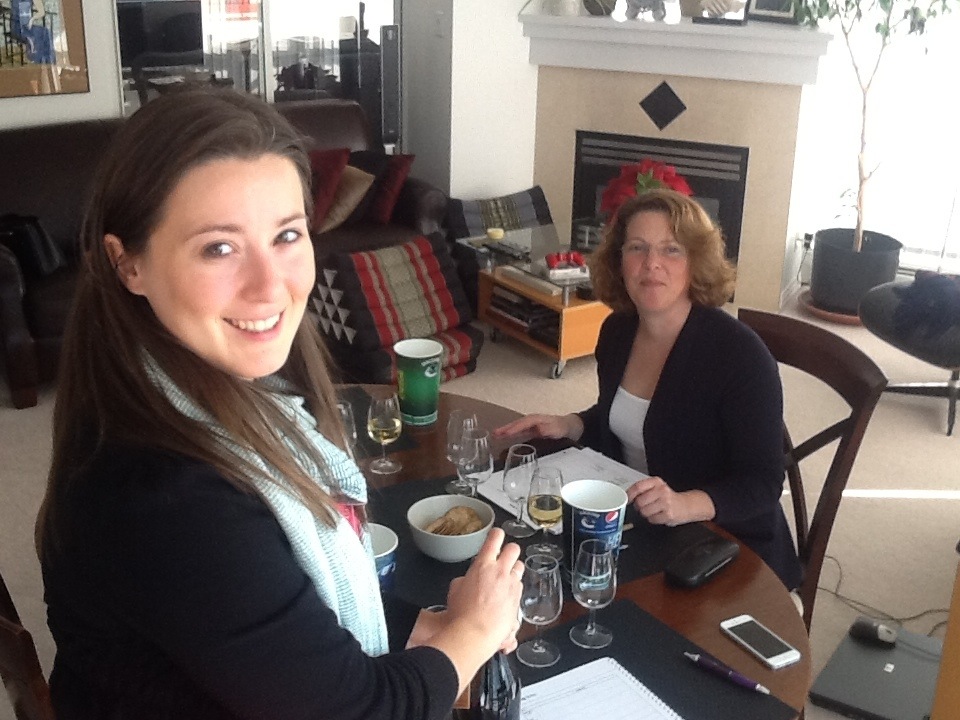
WSET Diploma Unit 5 – Sparkling Wines of the World – Tasting

Tasting notes from a study group for the WSET Diploma, Unit 5, Sparkling Wines of the World course …

Wine #1
Cava, Parés Baltà, Brut, Penedès, Spain, 11.5% abv, C$22.99

Clear and bright, pale gold, bubbles noted.
Clean, light intensity aromas of ripe red/yellow apples, white pear and peach, almond and yeasty bread, developing.
Palate is dry, medium acidity, low alcohol, prickly and aggressive mousse with medium minus flavour intensity of red/bruised apple, white peach and stone fruit, bitter yeasty bread and bitter almond/rubber quality (from the Xarel-lo) with a medium finish.

Quality: good, a varietally representative cava, simple, neutral and refreshing. Longer finish and more complex fruit spectrum would push it higher. Drink now, do not age – meant to be enjoyed young.
Varietals: Macabeu, xarel-lo, parallada, made in the traditional method

Wine #2
Villa Theresa Prosecco, Vino Frizzante, DOC Veneto, Italy, Organic, 11% abv, C$19.99

Clear and bright, pale lemon, bubbles noted (Frizzante).
Clean, medium minus intensity aromas of pear and white peach, nectarine, apple and slight honey with a floral quality (blossom/honeysuckle), youthful wine.
Palate is off dry, medium minus acidity, low alcohol, delicate Frizzante mousse with medium flavour intensity of ripe anjou pear, white peach and soft lime. Some of us detected some light green melon. Medium finish.

Good quality – fruity and youthful, but needs a longer finish and more complexity to push any higher. Would make a great wine to take on a picnic and super price point. Drink now and enjoy immediately – do not age.

Varietals: Glera, made in the tank method

Wine #3
Moet & Chandon, Imperial, Brut NV, Champagne, France, 12% abv, C$60.65

Clear and bright, pale gold with onion skin tint (Emily and Francine thought I was hallucinating), bubbles noted.
Clean, medium intensity, yeasty and yoghurt bread with lemon citrus and green apples, developing.
On the palate, dry with medium plus acidity, creamy mousse, medium minus alcohol, medium minus body and medium plus flavours of apples, brioche and yoghurt with hazelnut and a lingering tart lemon (I’m still finishing this one up – lots of lemon). Francine had us all imagining hot cross buns – really, it was the perfect descriptor for this generic House Champagne. Medium plus finish.

Very good quality – classic example of a big selling House Champagne (it’s blended from 100 difference parcels, 30% reserve wines), and the fruit and structure with the developing secondary characteristics are a boon. A longer finish would put this up a category. This is a generic big marque champagne – there is nothing unique about it.
Drink now or may hold for 3-5 years.

Varietals: 3 way split between Pinot Noir, Pinot Meunier and Chardonnay

Wine #4
José Dhondt, Rosé, Saignée , Oger, Vallée de la Marne, Champagne, France, 12.5% abv, C$70

Clear and bright, deep pink, bubbles noted.
Clean, medium intensity, yeasty with soft field berry, pomegranate and light cherry, developing.
The palate is dry with high acidity, creamy mousse, medium minus body with medium plus flavours of cherry, cranberry, rhubarb and field berry with brioche and creamy yoghurt. Medium plus finish.

Very good quality – great structure and balance with fabulous fruit and secondary characteristics. The only missing quality is a longer finish.

Varietal: 100% Pinot Noir, made in traditional champagne method

20130309-161629.jpg

Posted in Cava, Champagne, Industry Tasting, Prosecco, Sparkling Wine | Tagged , , , , , , , , , , , , , , , , , , , , , , , , , | Leave a comment

Burrowing Owl Estate Winery, Syrah 2009, BC VQA Okanagan Valley, 14.5% abv, C$29.90

Burrowing Owl’s tasting room was three folks deep with ‘splash and dashers’ last August when we dropped in for a peek. They wouldn’t give me an industry discount and weren’t terribly knowledgeable about wine in general to be honest.

I enjoyed other wineries we visited better, but did purchase this Syrah and opened it tonight to drink alongside BBQ’d steak with Montreal spice and fresh market salad.

Clear and bright, deep ruby with legs, on the nose it’s clean with medium plus, intense aromas of sweet baking spice, cassis and lightly confected tobacco leaves. The 14.5% alcohol is prominent in this developing wine.

The palate is dry but definitely has a sweet flavour that probably would have liked a BBQ sauce better than the Montreal steak spice, or perhaps even BBQ’d peaches with the meat. Acidity is medium and the tannins are velvety and smooth.

The alcohol is high on the nose, but here on the taste buds it’s integrated and the body is medium. Flavour intensity is medium as well and features sweet fieldberry, acai, clove, cherry and toffee. It’s not cloying, but definitely it’s noticeably sweeter than the average Syrah. The finish on this is medium.

A WSET good wine. The sweetness combined with the high alcohol on the nose detract from the general quality. That said, the fruit is fresh and full and the wine is nicely structured.

20130307-213239.jpg

Posted in RED, Shiraz / Syrah | Tagged , , , , | Leave a comment

‘Napa Rocks’, Napa Valley Wines, Vancouver International Wine Festival, 2013

Th 2013 theme at the Vancouver International Wine Festival was California, so a Saturday afternoon spent in a tasting seminar of some of those was in order. The ‘Napa Rocks’ presentation featured various wineries from the region that boasts 16 separate AVAs, yet produces a mere 4% of California’s wine.

Thirty miles long, 4 miles wide and only 32 miles from the cooling breezes of the Pacific Ocean, Napa Valley is comprised of many small lot producers, 77% of which produce fewer than 10,000 cases a year and 63% fewer than 5,000. A full 95% of Napa Valley vineyards are family-owned.

Interestingly, because of the geological history of tectonic plate movement and igneous rock formations, half of the world’s soil orders exist in Napa Valley. We also learned that the coolest AVA actually exists in the south at Carneros, mostly because of the cool breezes pulled in via the San Francisco Bay area from the ocean and the elevation.

There were two white wines featured – a 2011 Sauvignon Blanc from Heitz Cellars‘ Howell Mountain vineyard being the first. Established in 1961 when there were only 14 wineries in the region (now there are 400+), Heitz’s Sav Blanc was pale lemon with soft aromas and a medium intensity with low minerality and low acidity. There was some soft lychee and kiwi with Asian pear, no greenness at all and a surprisingly high alcohol level at 13.5% for a Sav Blanc. I found it a little round and flabby to be honest; simple and almost akin to an unwooded Chardonnay.

The second white was a 2010 Chardonnay from Signorello Estate called Hope’s Cuvée , after the owner’s late mother. I’ve had Signorello before, but hadn’t appreciated the owner is actually Vancouver raised and a UBC graduate.  Pale gold with baking spice sweetness, it had honey, almonds and caramel alongside a soft lemon crème with no bitterness on the palate. Not fined or filtered, it will throw a sediment – fine by me! It’s made from 30 year old vines and has been fermented and aged in French oak plus 10 months on the lees. A whopping 14.8% abv, it goes for US$90.

You can’t hold a tasting on Napa and not have Robert Mondavi in the lineup. We tried a 2010 Pinot Noir Reserve of which there were only 1000 cases made. It was medium ruby with elegant and dark cherries and raspberries. Very fruity, it also had a soft palate of forest floor, soft mushroom with dusty tannins. Again a high alcohol level of 14.5%, but it was nicely structured and complex. US$60.

The Antinori Family Wine Estate was next with their Antica, a 2010 Sangiovese. I found it acceptable and simple – medium ruby with sweet cherries and candied raspberries and black tea.  Medium acidity, medium smooth tannins and only $35 at their winery. Wine snob said Non and I agree.

Now, with the Black Stallion Winery 2010 Syrah, we were talking. This is a small winery that only makes about 3,500 cases a year total and 650 of this wine alone. This was WSET Very Good and full of cassis, plum and blackberry bramble. You could even smell the tannin.  Deep purple with tobacco and leaf, baking spice and some white pepper. Jammy but full of deep flavours and not sweet but with a small floral lift coming from the tiny bit of Viognier co-fermented with it. Picked in the Atlas Peak and Oak Knoll AVAs, it’s aged for 18 months in 30% new French oak prior to bottling. Available only at the winery, so I may have to pay them a visit.

Miner Family Winery featured a 2009 Cabernet Franc (8% Cabernet Sauvignon too) of which only 200 cases were produced. Blueberry, pencil shavings, flint and green tea with tobacco made this deep ruby wine lovely and aromatic. There was no greenness that one often associates with Cab Franc, but just lots of clean and fresh fruit alongside grippy and high tannins. Aged for 21 months in 60% new French oak, it has 14.6% alcohol. Very nice indeed.

Blackbird Vineyards brought a 2010 red blend called Arise (US$69). Merlot, Cab Franc, Cab Sav all aged in 70% new French oak, Chef Parker swore she tasted chocolate covered pistachios. I got lots of grippy, green tannins as well. My teeth started hurting at this point.

The 2007 Cabernet Sauvignon from Silver Oak Cellars was deep ruby and had green tobacco with fresh fruit. Surprisingly, I got mostly red fruit off this wine – cranberries and raspberries with mint and loads of tannin. Very youthful and clearly developing, this needs to lay down for a long time. It’s very sweet – likely a result of the US oak it’s aged in, 13.9% abv – and a whopping C$139.95 apparently.

The last wine of the afternoon was Pine Ridge‘s 2010 Petit Verdot. Opaque purple, it had a lovely floral lift of violets and rose petals, very high, grippy tannins and shone with strawberries and ripe cranberries, tobacco and white pepper. With 78% PV they’ve added in 10% Malbec and 7% Cab Sav and 5% Cab Franc. Aged in 30% new French oak, it has 14.5% abv and is only available at the winery.

By this point, I needed whitening strips and a toothbrush. I’m packing some for California.

Napa Valley, here I come!

Posted in California, Industry Tasting | Tagged , , , , , , , , , , , , , | 2 Comments

Alvear, Pedro Ximenez, De Anada, Montilla Moriles DO, Spain, 17% abv, C$35 (375 ml)

Sherry, sherry, sherry – it’s so versatile. Drink Fino with salty snacks – great with almonds, mackerel, sardines, potato chips or olives. Or choose an Oloroso, an Amontillada or some Manzanilla.

This Alvear Pedro Ximenez has been hanging around since Christmas – long enough!  So we opened it after an evening out at a local tapas restaurant for dessert.

Clear and bright, it’s got a beautiful medium amber colour, the tone of golden tobacco, with marked legs noted.
Clean with medium plus intense aromas of sultana raisin, straw, brown sugar, thick clover honey and baking spices. A fully developed wine from the solera.
On the palate, it’s sweet with medium acidity with medium fortification. Full bodied wine, it’s got medium plus flavour intensity of ripe raisins (not surprising considering it’s PX), dried grass and straw, caramel and toffee, honey, ginger and cloves. The finish is medium.
Overall this is a ‘very good’ quality wine – the flavours and aromas are nicely balanced and well-integrated with the alcohol which doesn’t overwhelm. The only thing lacking is a longer finish that would move it up to be ‘outstanding’.

According to Sandeman & Lea in England, sherry sales are up 20% over the course of 2012 – something they attribute to the drink being celebrated in Downton Abbey. I say ‘hear, hear’. Thanks a lot, Lady Mary, Carson and Lord Grantham. I tip my hat to you – and I’ll do my best to boost sales on this side of the Atlantic.

20130221-203642.jpg

Posted in FORTIFIED WINE, Sherry | Leave a comment

Dominio de Tares, Cepas Viejas, Mencia, Bierzo DO, Bierzo Alto, Leon, Spain 2008, 14% C$30

Purchased at a local specialty wine store, this is a great wine made from the Mencia varietal, aka ‘Jaen’. Mencia is grown primarily in North Western Spain, and especially in Bierzo, an up-and-coming DO. Ironic to say that as of course they’ve been making wine there for centuries – but it’s only in the past 70 years or so that improved plantings, densities, canopy management systems and winery hygiene has meant a positive change for the intensities, colours and flavours produced in these wines.

A clear and bright wine, it is deep purple with legs noted.
On the nose, clean with medium + intense aromas of black, black, black fruit – damson plum, blackberry, cassis, black currant – with a meaty undertone, violets and sweet spice. A developing wine.

It’s dry with high alcohol at 14%, medium acidity and slightly grippy and green tannins that at the same time feel dusty. Medium body complements medium plus flavour intensity of more fresh, full and extremely ripe black fruit – plums, black currants and berries with a hit of cranberry fruit. Definite meat and tobacco tones dominate accompanied by light forest floor and leaves. Light spice, black pepper and a medium plus finish delivers this wine.

A solid ‘very good’ wine – alcohol is high but integrated and not overwhelming. The oak is seamlessly combined. Fruit is full, ripe and complex, accompanied by a backbone of secondary characteristics. A longer finish would have pushed it into ‘outstanding’. Drinking now, but could be kept for up to 3 years to help relax the tannin.

Go see Bierzo – buy some Mencia. Me? I’m off to enjoy tapas at a local Spanish restaurant – If I can’t go all the way to Bierzo…Enjoy.

20130216-181955.jpg

Posted in Mencia, RED | Leave a comment

Black Hills Estate Winery, Nota Bene, Meritage, Oliver, Okanagan Valley, BC, Canada, 2010, 14% abv.

I bought this bottle at the winery in Oliver in August 2012 – and then brought it right back to the Okanagan to drink with Jennifer and Allan.  Fun!

This is Black Hills’ renowned Meritage blend of 57% Cabernet Sauvignon, 32% Merlot and 11% Cabernet Franc.  Clear and bright, it’s a deep shade of ruby with a bricked rim.

The nose is enticing with intense aromas of bramble, blackberry, cassis, cola and sweet baking spice notes including vanilla.

Dry with better than average acidity, the tannins are dusty and just every-so-slightly grippy.  While the alcohol shows a little high, the flavour profile is pronounced with ripe blackberry, bramble, cassis, black plum and boysenberry, licorice, leather, tobacco and vanilla oak.  A long finish accompanies the back end.

The components are clearly delineated and complex, with balanced fruit, tannin and acidity.  WSET Very Good Plus, it’s drinking beautifully, but could also be laid down for 5 years or even more considering the acidity, fruit and complexity.

20130209-195335.jpg

Posted in British Columbia, Cabernet Franc, Cabernet Sauvignon / Blends, Meritage, Merlot, RED | Tagged , , , , , , , , , , , | Leave a comment

Vinas Elias Mora, Toro DO, San Roman di Hornija, Valladolid, Spain, 2009 14.5% abv, C$19

Oh, Spanish wines – how we love and adore you.  Great deals, fabulous fruit, complexity… Let me count the ways.

The Elias Mora is from the northwestern corner of Spain, directly west of Ribera del Duero.  Made from Tinta de Toro, aka Tempranillo, this version is neither filtered nor fined.

Ruby toned, this wine is developing with medium intense aromas of red fruit as well as some dried prune with leather and some sweet baking spice.

The palate is dry with average acidity, slightly grippy and green tannins and flavours of cassis and black plum, dark red cherries, ripe red plums, leather, tobacco and a touch of black licorice.

A WSET Very Good wine – lovely balance between the flavour profile, complexity of fruit flavours, acidity and finish.  While the nose starts off light, it opens up after a short time in decanter.

Fabulous with charcuterie, olives, hommous and salsa. Drinking now,  but could wait for 3-5 years if you can resist drinking it.

20130209-194527.jpg

Posted in RED, Spain, Tempranillo | Tagged , , , , , , , , | Leave a comment

Lambrusco di Sorbara, Emilia-Romagna, Tenuta Casolari, Vino Frizzante Secco, Italy, 11% abv, C$15

Kelowna is the centre of the BC wine universe, but I brought something just a little different to Allan’s this weekend.

Lambrusco is both the name of the grape and the wine – and it comes from Italy’s north central Emilia-Romagna region. There are 4 types of Lambrusco, mainly produced in 3 provinces – Lambrusco di Sorbara (generally agreed to be the best version and made dry in the traditional method), Grasparosssa del Castelvetro, Salamino di Santa Croce and the Lambrusco Reggiano which is usually served amabile or sweet.

Most Lambruscos available outside of Italy are red, white or rosé , medium sweet and not of very high quality. The better quality ones are extremely food friendly – not surprising, considering they are produced in the bread basket of the country – and go extremely well with pasta and charcuterie. This one was purchased at a BC Liquor Store and was very reasonably priced at only C$15.00.

Clear and bright with bubbles, this is a pale tone of ruby with a garnet tinge.  The nose has aromas of juicy red strawberries and cherries with violets and the slightest hint of dry leaves.

The palate is dry and there’s a juicy with the delicate mousse.  Tannin is almost imperceptible and the alcohol is low making it easy to over indulge!  This wine screams ‘summer’ with its field berry, rhubarb, strawberry, cherry fruity flavours.  There is some backbone of wet leaves and smoke.

WSET Good plus and made in the traditional method.  The acidity is strong and the wine exceedingly food friendly.

Fun and decidedly cheery on this Friday in February Kelowna evening. Enjoyed with crab cakes and chipotle, charcuterie, cheeses and humous with market veggies and olives.

20130209-193305.jpg

Posted in Italy, Lambrusco, RED | Tagged , , , , , , | Leave a comment

Matsu, El Recio, Tinta de Toro, Toro DO, Spain, 14.5% abv.

If my sources are correct and El Recio refers to a ‘tough guy’ – then the picture on this bottle says it all!  He definitely looks tough.

The wine’s not though – and it’s one of my favourite types.  Spanish?  Check.  Red?  Check. Tempranillo?  Check.  Okay then.

Toro lies in Spain’s northeastern corner – east of Portugal’s Douro Valley and northeast of Madrid. It lies to the west of better known Ribera del Duero.  Some of the very best Spanish wine deals originate here.

This wine is made from 100% Tinta de Toro, aka Tempranillo and aged for 18 months in American oak barrels. All the red wines in the DO must be either 100% Tinta de Toro or may have some Garnacha.  The whites are from Verdejho and Malvasia.

This wine is a deep garnet and has aromas of black fruit, some cranberry, sweet mint, cedar and bramble.

On the palate, it’s a treat. Dry with medium acidity and slightly green and dusty tannins, the flavours include blackberry bramble, damson plums, ripe blueberries, sweet green licorice fern, cedar fronds, baking spice and a great finish.

WSET Good plus wine with a lovely fruit profile, nice complexity and balance.

Extremely enjoyable – go get some. Not tough at all!

20130127-212748.jpg

Posted in RED, Spain, Tempranillo | Tagged , , , , , , , | Leave a comment

Les Champs Vignots, Anjou AC, France, 2011, 11% abv.

Straight from France’s Loire Valley in the appellation contrôlée of Anjou comes Les Champs Vignots, a demi-sec 100% Chenin Blanc wine. We enjoyed this with goat’s cheese topped with spicy Thai chili sauce, pork pâté and fresh green grapes.

A pale shade of lemon-green, this lovely wine sports some light legs and aromas of citrus, pear, yellow apple and lots of minerality.

This is a youthful wine that is medium dry but that also has juicy, high acidity to balance out the sugar.  The alcohol is refreshingly low at only 11% and the body is quite solid at medium.

The flavours show light lemon zest, juicy Asian pear, a little yellow pear juice and white peach.

A WSET Very Good wine.  What lovely high acidity balanced with residual sugar. Especially perfect for appetizers or brunches.

20130127-212809.jpg

Posted in Chenin Blanc, France, WHITE | Tagged , , , , , | Leave a comment