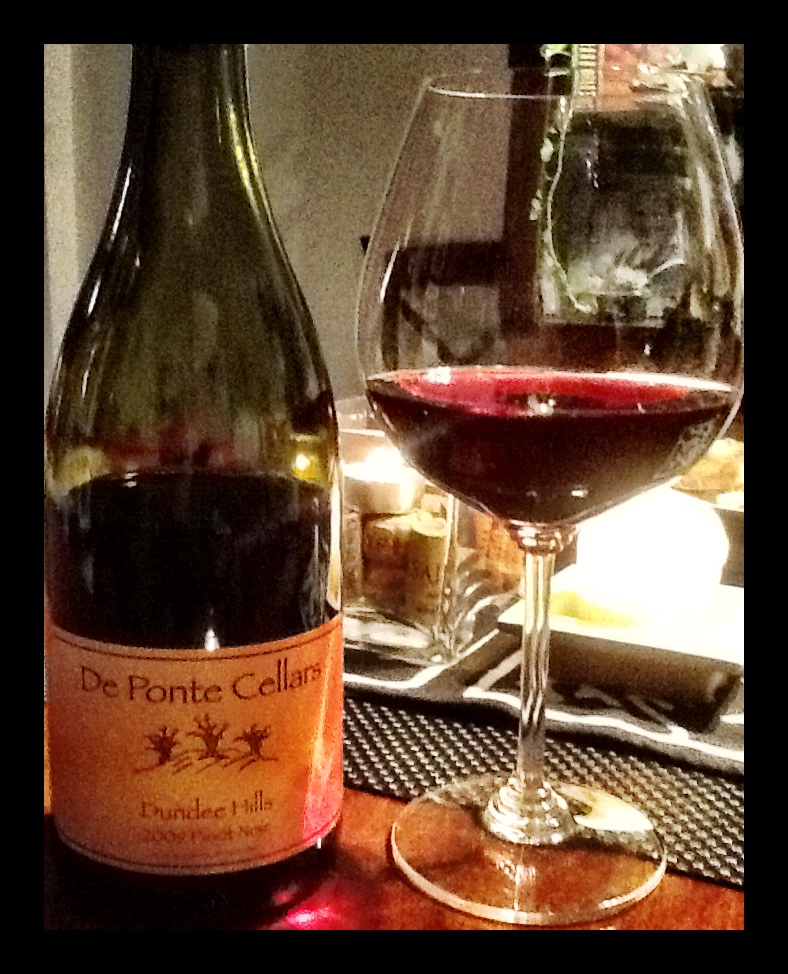
De Ponte Cellars, Pinot Noir, Dundee Hills, Willamette Valley, Oregon, 2009, 14.1% abv

de ponte 2dp 5Friends, Americans, neighbours to the south, what are you going to drink with your Thanksgiving turkey?

Yes, you can drink red wine with this meal, you really can.  There are many options to choose from.  Pinot from Oregon’s Willamette Valley is perfectly positioned to partner with your holiday bird.

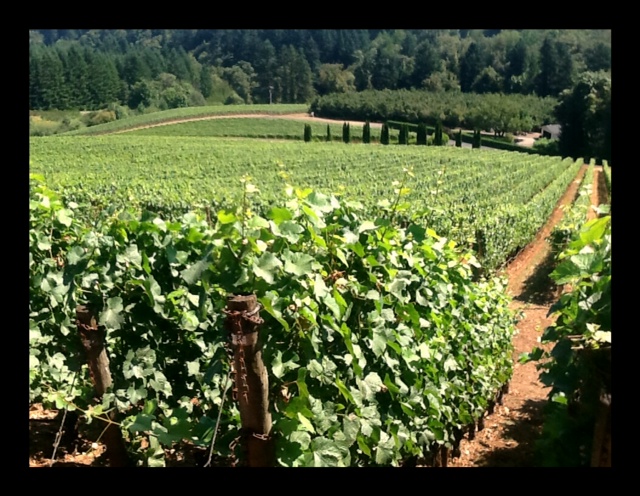
We visited De Ponte in 2013 on a hot August day intrigued by a recommendation from their neighbours at White Rose Winery (across the road) and Domaine Drouhin (located just up the hill).dp 4

We were greeted with a light palate cleansing white – their Melon de Bourgogne, a house specialty – and learned that their winemaker, Isabelle Dutarte, originally came to Dundee Hills from Paris to work at Domaine Drouhin.  They produce only about 2000 cases per year, so this is a fairly small enterprise.

dp 6The 2009 version is a medium garnet colour with lovely legs and medium plus intense aromas of youthful red fruit – raspberry, Byng cherry, cranberry and boysenberry – crushed cedar greens, minerality and clove.

In the glass, the wine is dry with medium plus acidity, ripe, silky tannins and high alcohol.  The medium plus intense flavours include more of the same red fruit as well as a hit of plum alongside a medium plus finish.

This wine is delicious (WSET Very Good) and aside from the high alcohol, it’s balanced and has lovely complex layers of fruit, minerality, wood, spice and acidity.

So, go Pinot – and let me know how it pairs with your cranberry sauce and stuffing.

Posted in Oregon, OTHER, Pinot Noir, RED | Tagged , , , , , | Leave a comment

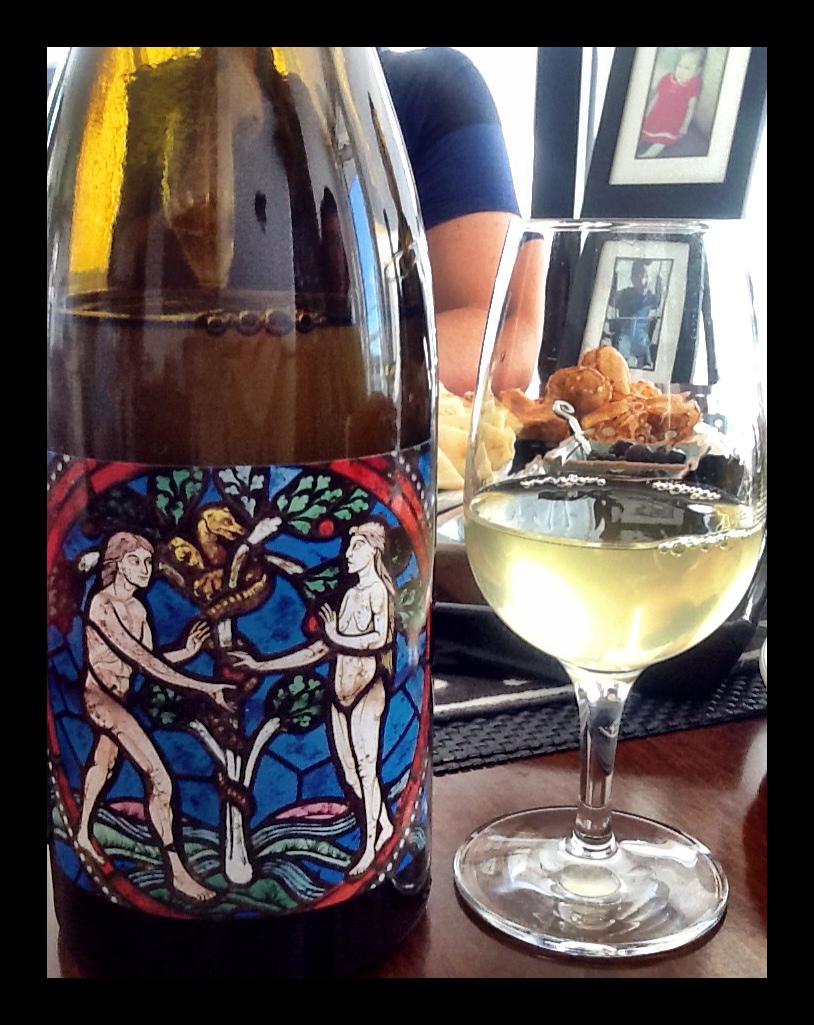
Carpe Diem, Melon de Bourgogne, Domaine de l’Ecu, Nantais, Loire, Vin de France, 12% abv, 2012

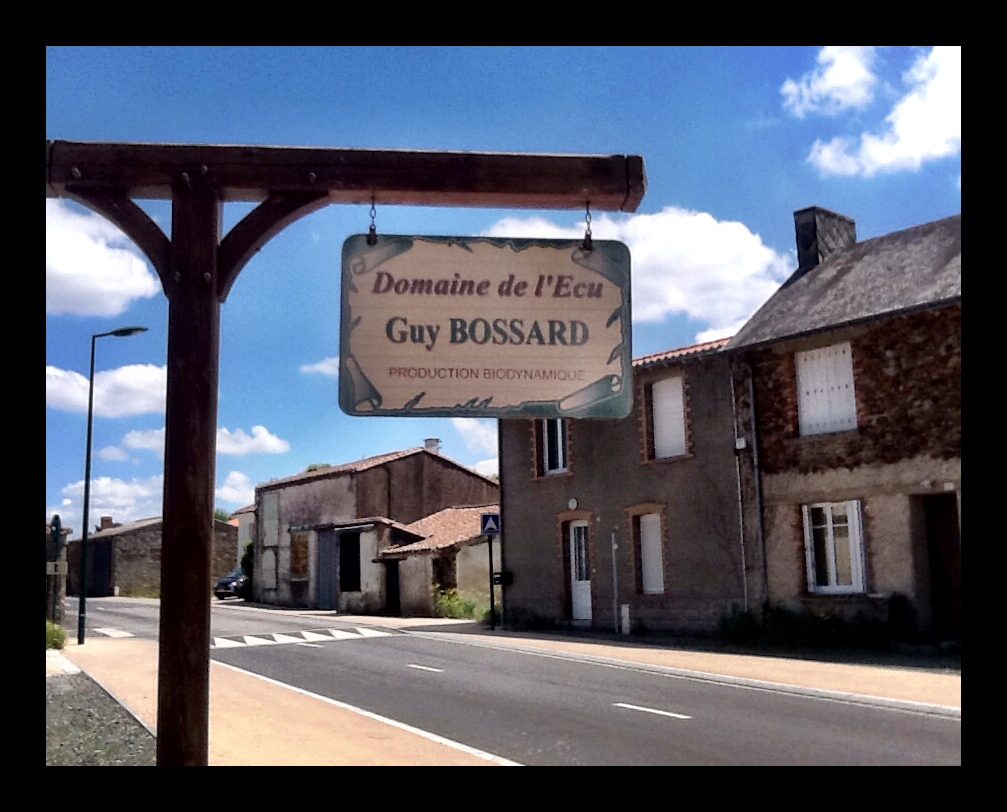
carpe 8 I visited Domaine de l’Ecu in June 2014 about a week after writing the final Diploma exam.  I was still recovering from WSET trauma – but eager to meet renowned winemakers Guy Bossard and Fred Niger van Herck at this winery located southeast of Nantes on the easternmost fringes of France’s Loire Valley.carpe 4

Under Guy’s control since about 1972, Domaine de l’Ecu has been organic since 1975 and Demeter-certified (biodynamic) since 1988.  Together with other biodynamic leaders (including Nicholas Joly, Olivier Humbrecht and Stephane Tissot), they belong to the group ‘Renaissance des Appellations’ which sports the url ‘return-to-terroir’ and whose basic premise for winemakers is to employ ‘…actions which permit an Appellation to express itself.

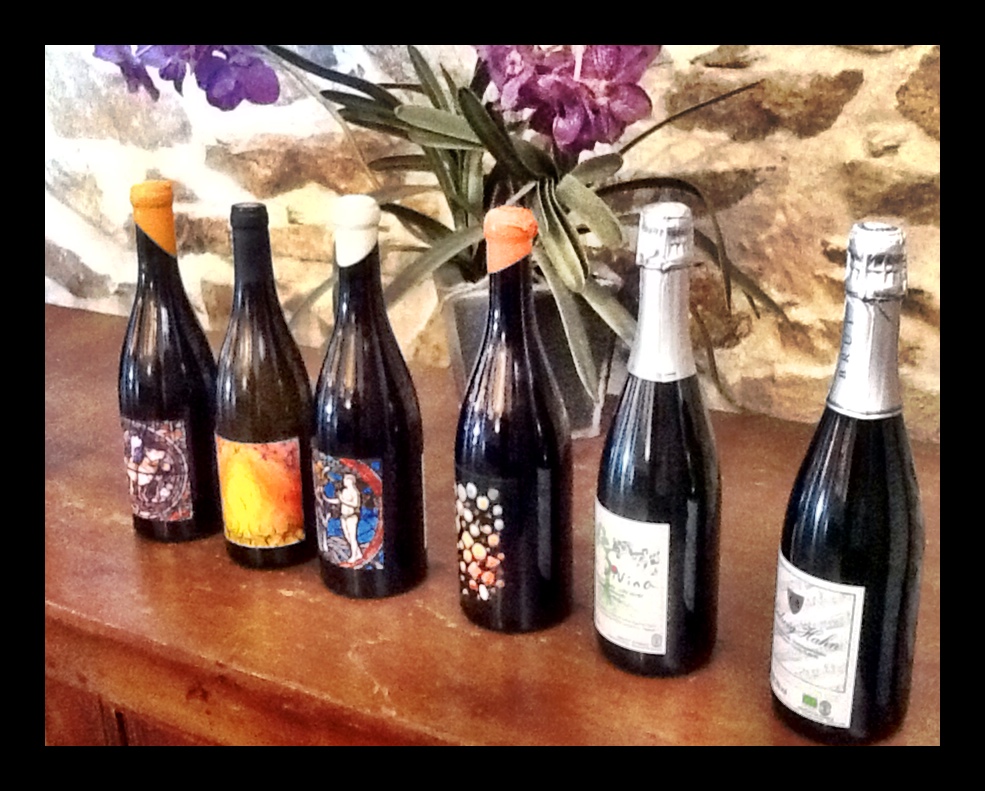
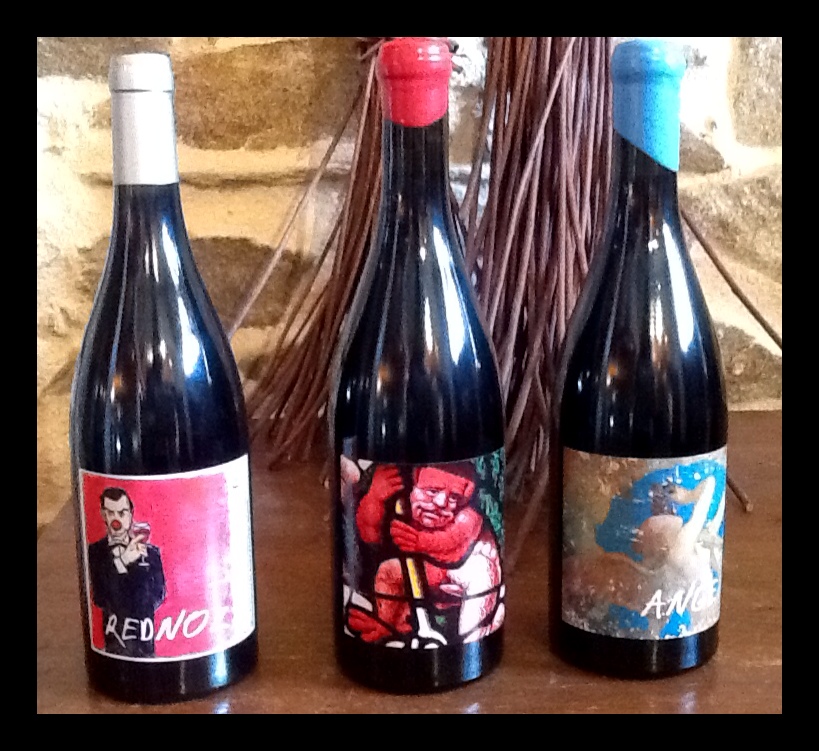
carpe 6Now in semi-retirement, Guy has handed the reigns over to a charming and dynamic Fred who has proven to be a more-than-capable successor.  Eager to espouse the tenets of biodynamic and natural winemaking, Fred talked endlessly during the visit about being forced to de-classify this wine (and others) from the Appellation because of “bureaucratic protests” regarding ‘typicity’ of flavour, aroma and texture.  Thankfully he has a great sense of humour – which shows in their marketing too (ie: they have a wine called ‘Red Nez’).carpe 3
carpe 9This wine is all natural, unfined and unfiltered with no added sulfites.  It was fermented with indigenous yeast and vinified completely in clay amphorae for 15 months.  It’s hazy because of its natural status and is pale lemon with heavy legs. The nose is heavily mineral and herbal with notes of fennel and lemon balm with a great sweet black licorice aroma.  Dry with medium minus alcohol and average acidity, it has medium plus body with medium plus flavours of more fennel, green herbs and lemon grass with that really cool didn’t-expect-to-find-it licorice note.

carpe 2 carpe 1Unctuous and full, this wine is rich in the mouth with a long finish.  WSET Very Good – is drinking now but can be held for 5-7 years.  Consume with as much seafood as is humanly possible.

I had waited a while to open this – the WSET Diploma Survivors’ Group meeting was the perfect moment for sharing.

Posted in France, Melon de Bourgogne, WHITE | Tagged , , , , , , , , | Leave a comment

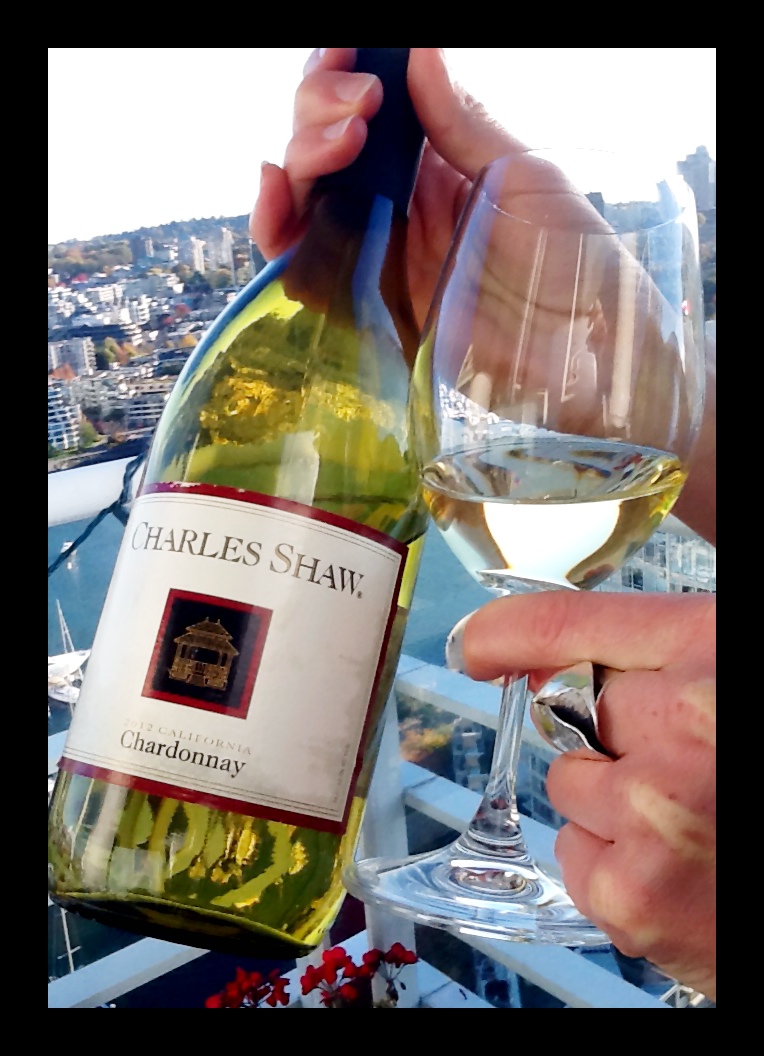
Chardonnay, Charles Shaw, California, 2012, 12.5% abv, US$2.49

Let it be said I will try just about anything – at least once.chuck

When I saw the infamous bottles of Two Buck Chuck on the shelves at Trader Joe’s during a cross-border shopping trip, I admit I was terribly curious.  I stole over to the display, sneaked a couple into the shopping cart and prayed no one saw.  ‘Cause you know I should really care what random shoppers think of my wine purchasing choices.

Really though, when you taste wine, you need to know what all of it tastes like – not just the classics, but wines of all types and quality levels.

However, once I’d justified it to myself, it still took me a year to crack one open.  And that was risky in and of itself; these are not wines to lay down and age.

Just who is Charles Shaw and why are these wines so gosh darned cheap?  There are lots of internet sites circulating urban and other myths, but fact is he was a Stanford Business School grad who bought a winery in 1974 with his wife.  When they divorced in 1991, it was sold to the Bronco Wine Company which revived the label in 2002 and sold their cheap wines to Trader Joe’s.

There was a lot of ruckus in August 2014 when the harvesting and vinification methods used were exposed – along with mention of animal bits and such being included in the process.  But, the fact is more than 5 million cases of this brand are sold each year.  Someone is buying it.

Before tasting, my first impression was that the bottle is a strange green-brown and very light weight.  Although it’s still the standard 750ml size, it has a broader shoulder and is shorter than most.  This must be to cut down on the size and weight of a case so that shipping costs are reduced.  I was also surprised that the bottle had a cork and not a screw top.

The wine is a pale lemon colour with uneven legs, a slightly alcoholic nose and has aromas of lemon, vanilla and unripe, green plum.  The palate doesn’t deliver on that though; it’s shockingly off dry with about 15 g/L of residual sugar.  The acidity is medium and although the alcohol is only 12.5%, it’s boozy.  The flavours show lemon, heavy vanilla, more green fruit and a bitter almond along with a strong oaky flavour that speaks of wood chips or added essence; no barrels were used during the making of this wine.  The finish is shallow and lightly bitter.

WSET Acceptable – and unbalanced with the unripe fruit, overt alcohol and sugared flavour.  Headache inducing, I actually poured the bottle down the sink rather than risk the full on migraine.  An industrial, manipulated wine.  Don’t age; lay this down at your own risk.

That said, it’s an ultra bargoon.  I know of other wines that people pay $8-$12/bottle for that are no better than this, so if cost is your driving motivation, at least you’ll save money.

For me though, life is too short to drink shoddy wine.  Once was enough.

Posted in California, Chardonnay, WHITE | Tagged , , , , , | 2 Comments

Espero, Tulip Winery, Galilee, Israel, 2012, 14.5% abv

IMG_4128It pays to have relatives living on the opposite side of the earth when your interests include tasting and writing about wines made in esoteric styles, or in off-the-beaten-track wine countries, or from unusual grapes.

Here we have a sample from Israel’s Tulip Winery located in the hillside town of Kiryat Tiv’on – just southeast of the coast city of Haifa and west of Nazareth.

Now, Israel is not exactly a newbie at making wine or growing grapes.  I mean, they’ve been doing that there since biblical times. In the Old Testament’s book of Deuteronomy, grapes were listed as one of the seven ‘blessed species’ of fruit found in Israel (Deut. 8:8).

That said, Israeli wines have seen a quality revolution since the 1980s when great investments were made in winery equipment and vinification methods. Many products, including this one, meet kosher standards (although that appears to have been a very difficult designation for Tulip to have attained; they had to approach more than 20 Rabbis before being able to make the requirements work with their workforce).

The Tulip Winery certainly is unique.  Established in 2003 by the Itzhaki family, they employ members of the local community, many of whom live with developmental challenges.  Their goal is to help these employees integrate into the local workforce just as they would in mainstream society.  Kiryat Tiv’on means ‘Village of Hope‘ in Hebrew – and it’s home for about 200 locals with special needs, 30 of whom work at Tulip.

This wine is a blend of Cabernet Franc for perfume and high red fruit notes, Merlot for plush body and some Syrah for dark fruit and spice.

The wine is clear, bright, medium ruby and has full legs and has a nose of medium plus, youthful aromas of fresh red fruit (raspberry and cranberry) with some blackberry, cassis and Damson plum, vanilla and baking spice.  There is a minerality as well that holds over to the palate which is dry with medium plus alcohol.  The tannins are medium ripe with some grip and the acidity is average.  Add a little cherry to the palate along with some light leather and a medium plus finish and you have a WSET Good+ wine with structure and reasonable balance.  Drink now or hold for 1-3 more years.

Not only is Tulip Winery admirably altruistic, they make good wines too.
Well played, Elinor and Aryeh – well played.

Posted in Cabernet Franc, Israel, Merlot, RED, Shiraz / Syrah | Tagged , , , , , , | 2 Comments

Viader, Cabernet Sauvignon and Cabernet Franc, Howell Mountain, Napa Valley, California, 2001, 14% abv, US$80

The first thing Doug said when I met him was ‘I only drink vodka and Californian wines’.  viader

Who says that?!  Then he sent me a bottle of Viader.  Now at least I understand the method of his madness – at least for the wines part.

Viader is one of those perched-on-beautiful-Howell-Mountain-east-of-St.-Helena-Napa-Valley-wineries that has had much success since its inception in 1986.  Producers of organically grown Cabernet Sauvignon and Cabernet Franc grapes on hand-tended vines, they pride themselves on the get-up-and-get-them spirit of founder, Delia Viader.

Her children and their spouses remain an integral part of Viader’s operations to this day where the vines are planted as in the Douro – on an east-west axis up and down the hillside to maximize exposure to the sun and minimize soil erosion.viader 2The wines are unfined and unfiltered – music to my ears.  Formed of 55% Cab Sav for structure and black fruit, and red fruit and perfume from the Cab Franc 45%, they are grown at Viader’s volcanic, loam soil vineyard in Deer Park at an altitude of 396m.  The grapes have a yield of about 50 hl/ha.

The first challenge was with a dry cork that broke, but after a little TLC and some careful decanting to avoid any deposit and corky bits, we got down to business.  The wine is a clear and bright, medium intense garnet colour with a thick garnet rim and plentiful legs (the picture is a little off).

The nose is clean and developed with medium plus intense aromas of dried black and red fruit – blackberry, raspberry, plum, prune and raisin – with clove and nutmeg spices, marzipan and roasted nut.

The palate is dry with high, but completely unnoticeable, alcohol and silky tannins.  Acidity is still medium plus and the flavour profile has an evolved medium plus intensity with deep and rich dried black and red fruit – plum, prune, dried blackberry and black raspberry – leather strap, dried tobacco leaf, clove, nutmeg.  The finish is long.

This wine is delicious – perhaps slightly past it’s prime, but still dreamy at 13 years old.  Balanced, complex, elegant, structured but restrained, developed and with integrated tannins.  WSET Very Good+; drink now if you still have any.

Now I know why Doug treasures his Californian wines.

Posted in Cabernet Franc, Cabernet Sauvignon / Blends, California, RED | Tagged , , , , , , | Leave a comment

Dominio IV, The Tango, Tempranillo, Columbia Gorge AVA, Three Sleeps Vineyard, Oregon, US, 2006, 13.8% abv, US$45

DIVO the TangoI’m so confused.

Most who know me would say that’s a permanent state (insert raised eyebrow here).  That aside, herein lies the source of my befuddlement.

This wine is made from Tempranillo, but the winery is based in Oregon’s McMinnville which is in the Yamhill wine region of the Willamette Valley.  Generally speaking this is not renowned Tempranillo terroir.

However, do a little digging and you learn the grapes are from the biodynamically farmed Three Sleeps Vineyard (love it) located northward in Mosier, Oregon – part of the Columbia Gorge AVA that straddles Washington and Oregon states.

This lies on the south side of the Columbia River just east of Portland.  Technically in the rain shadow of the Cascade Mountains and with an arid climate more akin to that of Yakima, there is much less rain here than in the Willamette, making it possible to grow Tempranillo in addition to Viognier and Syrah, among others.

The wine (The Tango) is an opaque garnet with with deep legs.  The nose is alcoholic but once that blew off, rich aromas of black and some dried fruit and vanilla spice were exposed.  The wine needed some decanting and opened more after 30 minutes to show deeper berry and leather.

The palate is dry with medium plus acidity and dusty ripe tannins with a good amount of grip yet for an 8 year old wine.  The alcohol is medium plus and although it was high at the outset, after aeration the wine had medium plus intense flavours of deep cassis, blackberry, prune, raisin, clove and nutmeg.  Leather, tobacco leaves and soy sauce rounded it out with a strong finish.

This was truly delicious (WSET ‘Very Good +’)- aged for 5 years prior to release and drinking beautifully with adequate acidity and dusty tannins carrying to the finish.

No longer confused by this point, we enjoyed the wine with our fresh pappadelle and bolognaise sauce, local heirloom tomatoes with fresh basil, buffalo mozzarella and a drizzle of Puligian olive oil, Serrano prosciutto and green Castelvetrano olives.

Allan bought this south of the border in Bellingham, WA at a tasting, but you can also drop into their beautiful winery in McMinnville or book at stay at their B&B located in Mosier at the Three Sleeps Vineyard.

Posted in Oregon, RED, Tempranillo | Tagged , , , , , | Leave a comment

Pinot Noir, Seven Terraces, Rossendale Winery, Canterbury, New Zealand, 2012, 13% abv, C$27

7 terracesWine is about people and community – it’s usually best enjoyed with others and it always has a story.

This Pinot Noir is no exception to that general rule.  From New Zealand’s South Island just 13 km south of Christchurch, it’s made from grapes grown at Rossendale Winery and supplied exclusively to Empson Wines Canada under the Seven Terraces label.

This is a family-owned vineyard that exports a Sauvignon Blanc in addition to the Pinot.  Winemaker Alan McCorkindale has twice been named New Zealand’s Winemaker of the Year and it’s clear as to why.

Clear and bright, the wine is a medium ruby with medium legs.  The nose shows medium plus aromas of raspberry, cranberries and salmon berries with holly, clove and mushroom.

The palate is dry with medium plus acidity and medium ripe tannin.  The alcohol is medium and the medium plus flavours show more raspberry and red plum with clove, vanilla and cedar frond with mushroom and forest floor.

Nicely balanced, this is a youthful wine that has some lovely complexity.  The finish is a medium plus and complemented our Thanksgiving turkey, cranberry with orange sauce, and brussel sprouts (think forest floor and leaves here).

Highly recommended for a turkey dinner – get it now!  It’s available in the UK under the ‘Rossendale’ label and in the US as ‘Cottesbrook’ at Total Wine and More.

Posted in New Zealand, Pinot Noir, RED | Tagged , , , , , | Leave a comment

The Tyrconnell, Single Malt, Irish Whiskey, Andrew A Watt & Co., Ireland, 40% abv, C$60

tyrconnellThe Tyrconnell was a horse owned by the Watt family that was entered into the Irish national stakes in 1876 and won against enormous odds of 100-1.

Now the name is used for this Irish whiskey produced at the Cooley Distillery, Ireland’s last independent distillery currently owned by Beam-Suntory.  This is also where the Connemara, Greenore and Kilbeggan whiskeys are produced.  Tyrconnell is double-distilled and made from a base of malted barley.

Easy on the eyes, it’s a pretty, medium gold with tiny, quick legs (like the horse?).  The nose is clean, elegant and fruity with medium plus intense aromas of honey, yellow and red apples, baking spices, biscuit and malt.

The palate is dry with smooth alcohol.  It’s very silky and exceedingly easy to drink (don’t say I didn’t warn you).  There is some complexity with a medium plus finish that consists of orange and lemon rind, more honey, applesauce, biscuit, vanilla, clove and cinnamon.

This is a nicely balanced, silky smooth Irish whiskey with a fresh and classy profile and finish.  WSET ‘Very Good’ – drink now and often.

Posted in Ireland, OTHER, SPIRITS, Whiskey/Whisky | Tagged , , , , , | 2 Comments

Genium Cellers, Costers vi de Guarda, Poboleda, Priorat DOQ, Spain, 2005, 14.5% abv

One thing I have learned about winemakers and winery owners is that showing even a little interest in their work usually yields immensely positive results for anyone wanting to learn more.  Most are keen to share and you realize very quickly that asking seemingly innocent questions garners reams of information and feedback – and of course, leads to more questions.genium

Corresponding with the group of six families who joined forces in 2002 and combined their 15 ha of vineyards located throughout Priorat DOQ reminded me of this simple truth.

Jordi Ossó i Estivill is the Export Manager of Genium Celler and the ‘unique partner who speaks some English’.  Lucky guy – he pulled the short straw to answer my email about visiting Genium Celler in January 2015.  And talk about genial and helpful.

Genium Cellers is housed on the ground level of a stone home located in Poboleda, Priorat (northeastern Spain, south of Barcelona) where the Carthusian monks of the appropriately named, ‘Scala Dei’ (stairs to heaven) first set up shop in 1253.  DetallCartoixaEscalaDei0

‘Costers’ means slopes and their 7 ha of vineyards lie at a precipitous and precarious 45 degree angle meaning that everything must be done by hand.

The 2005 version (50% Cariñena, 30% Garnacha, 10% Merlot and 10% Syrah) comes from a combination of vines that are about 90 years old and produce only about 300 g of fruit per year, as well as some planted in the 1980s that produce around a kilogram per year.  It was aged in French oak for 14 months prior to bottling.

I think this about sums it up, “We keep taking care of the old vines on the slopes, in spite of the low output and high costs.”  Their attention to the viticulture and vinicultural processes is apparent – this wine earned a 91 from Stephen Tanzer in 2007 and a long ageing window.  I opened this bottle in October 2015.

Clear and bright, opaque garnet with a medium garnet rim and slow, fat legs, on the nose the wine is clean with medium plus intense aromas of black fruit – blackcurrant, blackberry, black cherry – olive, tarragon, rosemary, old, wet earth, vanilla and crushed rock minerality.

We had to decant it heavily as it was very closed initially, but over the course of the evening, it showed more complex fruit and earthy mineral tones.

The palate is dry with medium plus alcohol that is not noticeable at all.  The tannins are medium plus, but ripe and softly dusty.  Acidity is medium plus and the medium plus flavour profile includes more blackberry, lots of black cherry, cassis as well as dark plum, star anise, rosemary, thyme and tarragon, black olives, soy sauce, wet, overturned earth and rocks.  A medium plus finish complemented the palate.

WSET ‘Very Good’, this wine is drinking beautifully right now.  We enjoyed it with rib eye steaks prepared simply with salt and pepper, grilled peppers and fresh baguette with extra virgin olive oil.  It’s well balanced and still has a lot of fruit and good acidity working in concert with the dusty tannins.

If you’re lucky enough to still have a bottle lying around, enjoy it now (decant about an hour prior to indulging) or within the next 1-2 years.

Hopefully in January 2015, I’ll be able to try other Genium Celler wines when we visit Jordi in Poboleda, Priorat.  Stay tuned…

Posted in Carignan, Grenache / Garnacha, Merlot, RED, Shiraz / Syrah, Spain | Tagged , , , , , , , , | Leave a comment

Pinot Noir, Proposal Bloc, J Wrigley Vineyards, McMinnville AVA, Willamette Valley, Oregon, USA, 2012, 14% abv

Little brother Allan purchased this across the border in Bellingham, WA where the owner of the winerywrigley and winemaker, John Wrigley, was doing a tasting.

I have a soft spot for McMinnville having visited several wineries there in August, 2013.  There is some stunning countryside in that part of Oregon – rolling hills, hazelnut groves and Douglas Fir trees.  The International Pinot Noir Celebration is held there (at Linfield College) every year as well.

mcmimmThis, of course, bodes well for the reputation of the average Pinot Noir coming from the region and the J Wrigley example doesn’t disappoint.  This is delicious wine.

J Wrigley is a young winery established in 2006, vines planted in 2008 on 32 ha of land and with sedimentary and volcanic soils.  Located just a few kilometres south of McMinnville, they planted Pommard and Dijon clones 115 and 777 on south and east facing slopes that start at 64 and extend to 225m (where the whites are planted).  The vines are dry-farmed and they introduced their estate label in 2011.

The wine is day bright, medium ruby red with medium plus legs that seem high for a Pinot.  The nose has medium plus intensity of minerality – like sharp, wet rocks – along with lots of red fruit – Byng cherry and raspberry, pomegranate, red currant and red plum – with strong garrigue, cedar frond and licorice fern.

The palate is dry with medium plus ripe and dusty tannins with light grip, medium plus acidity, medium plus alcohol and medium body.  The medium plus intense flavours include more of the same ripe red fruit found on the nose with dried thyme, rosemary and lots of sage.  The cedar is evident and speaks to the time this wine from Pommard clone vines spent in barrel.  More anise and sword fern round it out.  The finish is medium plus.

Well balanced and not alcoholic despite the medium plus 14% abv, this is tasty wine with a very modern profile.  WSET ‘Very Good’ – drink now or keep for 3 years.


Posted in Oregon, OTHER, Pinot Noir, RED | Tagged , , , | Leave a comment