Trine, Pepperbridge Winery, Meritage, Walla Walla AVA, Washington, 2009, 14.1% abv

Purchased back in March 2013 during a trip to Walla Walla and a visit to the winery, this wine made an appearance over Canadian Thanksgiving with friends, family and a chilli dinner.

Clear and bright, ruby turning to deep purple with legs, on the nose this was clean with medium plus intensity and aromas of violets, blackberry, vine, cassis and bumbleberry. Comprised of 45% Cabernet Sauvignon, 43% Merlot, 6% Cabernet Franc, 3% Malbec, 3% Petit Verdot, it is from the Seven Hills and Pepper Bridge vineyards in Walla Walla Valley.

The palate was dry with medium plus alcohol (high by the percentage, but it didn’t drink that high), high acidity, grippy tannins and medium plus flavour characteristics of boysenberry and leather glove, blackberry vine, liquorice and black pepper with violet. This wine was aged in 100% French oak (44% new and 56% second fill) for 20 months and had a long finish.

The tannins and acidity will enable it to age at least 5-7 more years although it is drinking beautifully now. A WSET ‘very good’ integrated wine with lovely fruit and secondary flavour characteristics.

20131108-211541.jpg

Posted in Cabernet Franc, Cabernet Sauvignon / Blends, Malbec, Merlot, Petit Verdot, RED | Leave a comment

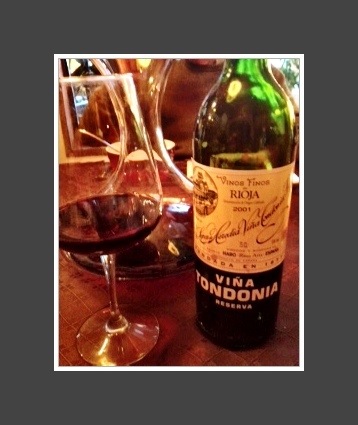
Viña Tondonia, Reserva, López de Heredia, Rioja Alta, Spain, 2001, 12.5% abv.

It was a small miracle of a find – bottles of López de Heredia at the liquor store on sale no less. My happy day was due to someone ordering in a case and then reneging.  Who does that to a case of Tondonia?

Out it came for a dinner of homemade chilli, fresh salad greens and breads. Comprised of Tempranillo (75%), Garnacho (15%), Graciano and Mazuelo (10%) all from the López de Heredia vineyards, it was clear and bright, medium plus ruby with legs.

On the nose, clean with medium plus intensity and aromas of apple pie, cinnamon and baking spice, ginger, clove, black pepper and blackberry.  I know – you’re thinking, ‘Apple pie? She’s off her rocker.’ But the aroma was unmistakeable.

The palate was dry with medium plus acidity, smooth tannins with the tiniest bit of grip, medium alcohol and medium plus intensity with flavours of ripe, red Macintosh apples, spiced apple pie, damson plum, blackberry and cassis.

Alongside was a lingering black pepper, baking spice, sweet tobacco and light leather. The finish was long. This unfiltered wine was aged 6 years in barrels before bottling, racked twice a year and fined with fresh egg whites.

WSET Outstanding wine – the fruit and complexity were layered, intense and exciting with the apple pie, spice and blackberry.  Considering the acidity and tannins, it’s possible for this wine to be aged even a little longer although López de Heredia recommends 10 years optimal.

A pleasure to drink.

20131108-205452.jpg

Posted in Graciano, Grenache / Garnacha, Mazuelo, RED, Tempranillo | Leave a comment

Wine Tasting and Celebrations at the Wickaninnish Inn

The weekend retreat we took to Tofino to celebrate two special occasions demanded some special feeding and drinking to go along with it. We found no shortage of folks at the Wickaninnish Inn willing to assist with the creation of perfection. From start to finish, the experience was a precise melding of namaste, top quality service, attention to minute detail and comfort.

A few of our experiences merit special mention. The tasting menu on our first evening was something I’d been looking forward to for weeks. We hadn’t been here for 10 years, and the Pointe restaurant is renowned for their tasting menus and artfully crafted West Coast cuisine. To say I was excited doesn’t come close.

I started with a ‘Toronto’. Now, lest you be concerned the Winellama is slipping somewhat, if you know her well, you recognize she’s been studying for the WSET Diploma Spirits exam lately. This involves lots and lots and lots (and lots) of reading, researching, note-taking and then loud panicking over not being able to tell the differences on blind tastings between all white spirits and all brown spirits and the like.

Never one to be happy with anything run-of-the-mill, I’ve also been reading up on unusual spirits and bitters. One of which is Fernet Branca (watch for the essay on this later). Basically, this is the second best selling amaro/bitter in the world, is made by the Fratelli Branca company in Italy and is alcohol comprised of 28 infused macerated and distilled barks, nuts and herbs. They’re apparently responsible for 75% of the world’s saffron market! Adored by ‘nerdtenders’ especially in San Francisco and Argentina (!), Fernet Branca smells like your dentist’s office. Spearmint, peppermint, heavy herbs and roots (no, not that kind). I know – you’re drooling, right? And it’s not from the novocaine.

Cue the ‘Toronto’. A shot of bourbon, half a Fernet Branca, some Angostura bitters, a dash of maple syrup and a flamed hit of orange citrus (I was worried our stellar server Hailey may hurt herself!). Fernet is horrid on its own – but this was really great. Somehow the citrus and bourbon served to mollify the bullying Branca.

But now onto the real reason we were here. The first course was the cold-poached Georgia Strait scallop with roasted spring onion, onion leaves and yoghurt accompanied by Blue Mountain’s Pinot Blanc (2010, BC). This was followed by the Camelina Poached Salmon with heirloom carrot, brown butter and whey paired with Henri Bourgeois’ ‘Les Barrones’ Sancerre (2011, France). The third course was a seared Quebec Foie Gras with roasted poultry jelly, raspberry vinegar and burnt walnut matched perfectly with the Tantalus Pinot Noir (2010, BC).

Now, I wasn’t feeling too sharesies at this point – after all, this was going preeetttty darned well, thank you, very much. It was about as close to perfection as a meal can get. But since Brian was practically incoherent about his Sable Fish with lobster mushrooms and watercress, I gave in and had a bite. The fish was akin to butter – melt-in-your-mouth consistency and with phenomenal flavour.

The pièce de resistance ended up being course number 4. I’d actually not wanted the food initially. It looked brave sitting there on the menu – Avonlea Cheddar with cauliflower, parsley and raisin. It sounded like something my grandmother would have made me eat when I was five. I chose it for the wine pairing – Lustau Dry Oloroso ‘Don Nuno’ (NV, Spain). The sherry was all salted caramel, sea spray, toffee and flor covered raisin. On their own, each was a little awkward and lonely. But put them together and ‘presto’.

Several descriptors came to mind, but because this is a PG rated blog, I will simply say ‘sensual’. Ike, was it you with chefs Warren Barr and David Sider who gave birth to that combination? Raises all around. Seriously. I would have never guessed. Tears-to-my-eyes outstanding. I couldn’t stop talking about it – ask Brian (cue eye roll here).

While we’re talking about Ike, the Inn’s Sommelier and Wine Director, it’s important to note the Inn has been recognized by Wine Spectator since 2002 and has received the “Best Award of Excellence’ every year since 2007 for it’s beautifully-rounded wine list. They’ve searched out the best of the BC wineries, many of which are uniquely boutique and augmented those choices with international options at all price points. I was delighted to see some Vista D’oro on the menu – and can’t help but wonder if some of their jams wouldn’t also compliment the cuisine.

Brian had set up a private tasting for us through Ike with Hailey. We had a marvellous couple of hours doing a double blind tasting (okay, I got 5/8 right). The Unsworth Pinot Gris (2012, Vancouver Island, BC) threw me (thought it was a Pinot Blanc) and I confess I thought the Elias Mora Tempranillo (2010, Toro, Spain) was a Meritage. Loved the Lustau East India Solera and appreciated the Venturi-Shultze (2008, Vancouver Island) dessert wine. The extremely light body combined with raisiny, honeyed sweetness was confusing. The gracious and ever-professional Hailey had great pairing ideas for it.

What makes places like the Wickaninnish Inn outstanding and award-winning? It’s the people. We commented on it the entire weekend long. From the repeated ‘happy birthdays’ and ‘happy anniversaries’, to asking us how we’d enjoyed the tasting, to Ron the concierge who literally dropped whatever he was doing to get to the lovingly First Nations carved doors to open them for us, to the enthusiastic, professional and friendly staff we met at each and every turn.

I will never forget the disapproving tsk tsk of our server at The Driftwood Cafe who was perturbed we’d been given the wrong soup spoons in our napkin rolls. And when we came back from dinner to find our room had been turned down, a fresh bucket of ice had been brought and a West Coast artist’s CD was playing in the Bose, I smiled. The devil is in the details and the Wickaninnish Inn and their people know it.

I love going to places like the Wickaninnish Inn precisely because of this. I am one of those highly sensitive (orchid-like, I’ve been told), notice-all, hyper aware people most average retailers, restauranteurs and hoteliers dread. But the Wickaninnish Inn can fear not – it’s completely obvious they follow all the best rules by finding, attracting and retaining the best people with passion – those who yearn to do a first class job. It shines forth in everything they do and say.

20131027-190935.jpg

20131027-190957.jpg

Posted in OTHER | Tagged , , , , , , , , , , , , , , | Leave a comment

V O D K A – WSET Unit 4 Spirits Preparation

V O D K A

The word ‘vodka’ comes from the Slavic ‘voda’ meaning ‘little water’. One of the oldest spirits around, there are references to it being distilled as far back as the Middle Ages – as early as 1405 in Poland and 1450 in Russia (at the Chudov Monastery).

In fact, there is an ongoing feud between the Poles and Russians regarding who first started making the spirit; the Poles are generally accepted as winners in that regard. However, the Russians are credited with inventing and perfecting the role charcoal filtration continues to play in vodka production.

Some have pondered why such a high alcohol spirit ended up being made in this part of the world (it is 96% abv in Europe and 95% abv in the US off the still, and min 30% abv when bottled in the US and minimum 37.5% in Europe). Most agree the high alcohol levels are a logical result of living in such cold weather; it won’t freeze in the bottle.

Vodka is made in a continuous multiple column linked still and the HRS (highly rectified spirit) is removed from the still at plate 42. It should have neutral flavours and aromas with few congeners and may be made of any agricultural product. Vodka must ‘retain a minimum character of the raw material’.

The most common bases are wheat (dry, elegant, neutral vodkas with a touch of anise like Smirnoff), corn (ethereal, light, delicate and soft), barley (crisp and dry with no oil like Finlandia), rye (spicy, citric, oily and clean like Belvedere and Wyborowa), molasses (sweet’ish), grapes (like Ciroc) and even potatoes (creamy, soft mouthfeel – enzymes must be added prior to fermentation and a de-methyliser must be used to remove methanol. Examples include Poland’s Cracovia and Chopin).

When vodka is distilled, the rectification plates in the rectifying column help to maximize the liquid and vapour contact. The theory is that the liquid settles on the plate and vapour heats and forces its way through because alcohol boils at 78.3c (lower than the 100c for water). This means the volatile congeners rise and lesser ones fall back (in a process called reflux) to be redistilled.

Making vodka is a real balancing act; butanol, propanol and methanol (definitely) must be removed while sugar, oil, water and ethanol are retained. There are two main types of vodka – neutral vodkas which are characterized by large international brands such as Skyy (US) and Smirnoff and characterful vodkas known best for preserving more of the base product character and congeners. Some of these examples include rye and potato vodkas especially from Poland.

A recent arrival to the vodka scene and done in an effort to drive sales and attract a new demographic to drinking vodka is the advent of flavoured vodkas. There are many featuring fruit, citric and spice additions/infusions as well as others that have been around longer – one being Zubrowka that runs the vodka through dried bundles of bison grass. (The active ingredient in bison grass is coumarin which is banned by the US FDA, so you can’t buy it there, but it is available in Canada. )

In past times, after being pulled off the still, vodka was then filtered through sand, egg whites, pottery shards or eventually activated charcoal. Russia’s Peter the Great had a private still through which he filtered his vodka 3-4 times, the last time through anise. Many, if not most, producers still filter their vodkas today – and will boast proudly about double or even triple distilled versions. However, many argue it is anachronistic and unnecessary because with today’s multiple linked column stills being so adept at removal of fusel oils and congeners, it is overkill and only done for marketing purposes. Finlandia argues that it’s ‘obsolete technology’.

Charcoal serves to soften the harsh characteristics and removes colour. The vodka is either pulled through the charcoal with a vaccum or pushed through a filter which must be monitored as when it’s too full, it cannot remove anything. It’s vital to remember that charcoal filtering can remove additional congeners and colour, but it cannot fix a badly made spirit.

Today’s best selling premium vodka is Diageo’s Smirnoff which sells more than double (25.8m cases in 2012) than the next closest competitor (Pernod Ricard’s Absolut Rent Brannvin from Alhus, Sweden). An up-and-comer to watch is Bacardi’s Grey Goose which burst onto the scene in 2000 with only 200,000 cases sold. However, by 2004 (1.2m cases) it was sold by founder Sidney Frank to Bacardi in the most expensive brand name spirit sale for US$2B.

This spirit which has been around for so very long, is undeniably big business.

Posted in OTHER | Leave a comment

RUM – WSET Spirits Unit 4 Preparation

R U M

Known in past times as ‘kill devil spirit’ or as ‘rumbullion,’ no other spirit has as many types or ‘marks’. It can be light, golden, spiced, dark, old vatted, navy, or vintage, made from a mixture of molasses and water or from fermented sugar cane juice and from countries as widely flung as Australia, Philippines, Jamaica, Guyana, Brazil and India.

Neither has any other spirit had the ‘hideous waltz’ (Dave Broom, ‘Rum’) that rum has had with slavery, sugar and rum. Some cities were literally built on this triangle including Nantes and Bordeaux, Liverpool, and Newport, Rhode Island. The trade of African slaves sold to Caribbean plantations to produce sugar that was sold in Europe and America – and then rum as well which was subsequently used to buy more slaves – went on for over a hundred years. A middle class drink in London and Europe during the 1800s, few truly realized the true extent upon which their enjoyment of the spirit was built upon the misery and destroyed lives of so many.

Most rum is made from molasses and to get molasses, one needs sugar cane. It is possible to have 1 (February to June) or 2 harvests a year (further to the tropical south) and the cane typically grows to 10-12 feet tall and when harvested (by hand or machine) it yields 12-14% sucrose. Most plantations will grow several species incase of disease. It must be transported as soon as possible to the processing mill (as the Jamaicans say, ‘from kill to mill in 24’) so that the sugars don’t deteriorate too much.

At the mill it is chopped, crushed and pressed and the sugar cane juice is collected. It’s boiled into a syrup, clarified and boiled again and then centrifuged. The sugar crystals are picked out and eventually the gooey, black residue left is what we know as molasses.

Because today’s processing mills are so adept at getting most of the sugar out of the sugar cane it’s actually becoming problematic for rum producers because the molasses used in rum production must have at least 52% sugar in it. It’s becoming increasingly difficult to find that high a level of sugar in molasses. To make matters worse, many major rum producing countries even have to resort to importing molasses (ie: Jamaica and Barbados) from Guyana, Brazil or Venezuela.

This means it’s more expensive to produce because it’s harder to extract sugar from each ton of molasses. Generally speaking one requires 2.5 kgs of molasses to make 1 litre of rum at 57% abv.

The next step is fermentation but because molasses is so sweet and the yeast would die too quickly, it is diluted with water prior to adding the yeast (about 10%). The level of dilution affects the type of ‘mark’ of rum that will be produced. Wray & Nephew (Appleton Estate, Jamaica) produces several different marks so they can blend them together.

Yeast is very important to rum producers – it attacks the sugars and produces CO2 and alcohol. Most producers will either swear by their own special brand of yeast (Bacardi’s is kept under lock and key) or buy a commercial brand (that they’re sure will produce exactly the type of rum they want). A very few artisanal producers still use ambient yeast (ie: Callwood Estate, Virgin Islands). The reason yeast is so important for flavour is that it doesn’t only produce alcohol, but also butanol, propanol and methanol (which no one wants in a spirit!) and also the precursors of aromas and congeners.

Fermentation is important because not only does yeast affect the flavours and aromas of each mark, but the length of the fermentation does as well. For example, the length of the ferment affects the concentration of acids and aldehydes (esters – ‘high’ aromas). So, the longer the ferment, the more deeply concentrated the acidity and concentration of the aromas.

Jamaican rums take fermentation to an art form – at Wray & Nephew, their ferments can last from as few as 30 hours to over a week! Even Dunder and sugar cane millings may be added to the very long ferments to increase acidity (Dunder is the acidic mess/spent lees left in the pot after the first distillation, fermented further in Dunder pits in the heat and added into the retorts during distillation – in Bourbon production, they’re called backset and used for sour mashing).

In Jamaica, rums are classified according to their esters (organic or volatile compounds produced during fermentation); a Common Cleans has about 80-150 esters, Plummers 150-200, Wedderburns 200 or more and Continental Flavoured 500-1700. The style is directly connected to the length of the fermentation. So, a Plummers may have been fermented for 2 days, a Wedderburns 3-4 and a Continentals as many as 5-10! Controlling heat is often a problem with the fermentation as it’s the tropics after all! Some producers cool their fermentation tanks and others control the fermentation by dripping in the molasses to the tanks over time so as not to overwhelm the yeast.

Traditionally rum was distilled in pot stills, made in small batches with an alcoholic wash of about 7% (so 93% water). Today some still are, but many of the lighter marks are made in multiple column continuous linked stills (ie: Bacardi’s iconic Superior is distilled in a 5 story tall one).

As alcohol boils at a lower temperature than water, the theory is that the alcohol vapours will evaporate and travel across the lyne arm to the condenser where they’ll be collected as spirit after cooling. The first time the spirit is only 23% abv, so it must be done another time to reach about 72% abv. The heart is separated from the low and high wines and retorts (closed copper vessels that concentrate the spirit further) are used as well. Retorts contain the low and high wines from the previous distillation and concentrate the spirit even further.

The talents of the distiller are of vital importance at this point as only he/she will know the proper cut points at which to separate the high wines, heart and low wines at. The heart will be collected from the retorts and the still at 85% and the low and high wines recycled back into the next batch’s retorts. Each country has a specific style – Jamaican rums are high ester and Guyanese rums tend to be weightier and less pungent (from the Diamond Distillery Ltd with its historic and one-of-a-kind Greenheart Wood pot stills).

The rum run usually follows high wines notes of flowers, apple and unripe banana, followed by the heart which is tropical fruit. The low wines are progressively heavier and the fusel oils appear after leathery and oily notes, followed by some rank and unpleasant ones.

Posted in OTHER, Rum/Rhum, SPIRITS | Tagged , , , , , , , , , , , , | Leave a comment

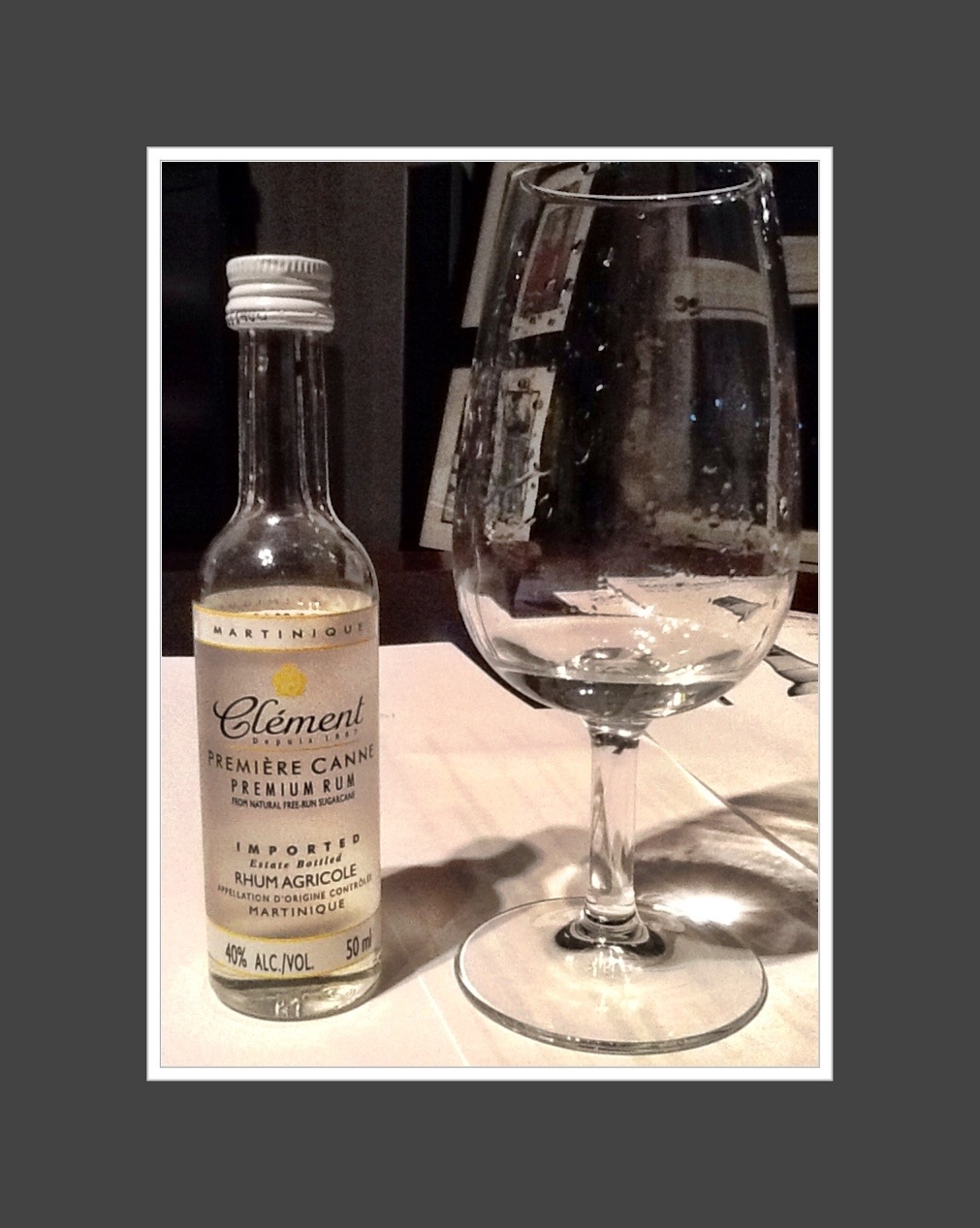
Clement, Premiere Canne, Premium Cane Rum, Rhum Agricole, AOC Martinique, 40% abv

Rhum Agricole is a form of rum popular in the French islands of the Caribbean including Martinique (where this one is from and which has AOC status), La Reunion, Haiti, the Dominican Republic and Guadeloupe. It’s made from fermented sugar cane juice and not molasses as all other rums are. The reason for this was the change France made in the early 1900s when the country switched to using cheaper sugar beets for sugar production instead of sugar cane. Because of this, there was no reason for the factories in these countries to process the sugar cane into sugar for export and thus, no molasses was produced.

In an effort to stay afloat financially and to continue producing rum, the French Caribbean producers turned instead to sugar cane juice as the base product for this rum variant. The cane is harvested and transported to the factory where it’s pressed for its juice (this particular example says it’s ‘from natural free run sugar cane). The fibres (‘bagasse’) are used as distillery fuel and then the sugar cane juice is fermented – often with dunder added to the process. Dunder is the sticky, acidic residue left in the still post distillation. When added back to the fermenting liquid, it increases the acidity and creates high numbers of congeners (flavour and aroma compounds) in the resulting spirit. In Jamaica, dunder is stored out in the heat in pots encased in the earth and allowed to fester and become even more acidic.

The alcoholic wash that results is usually 4.5-9% abv and is called ‘vessou’. The vessou is distilled in a single column still, exactly the same as the one used in Armagnac and also in Bourbon. This causes the spirit to be lower in alcohol than many other spirits (65-75% as per AOC Martinique law) and higher in congeners than most. It’s usually bottled at about 40%.

Rhum Agricole is described according to how it has been aged with ‘rhum blancs’ being unaged, water-white and colourless, ‘ambre’ has some vatted age, ‘paille’ has been aged for 18 months in wood and ‘vieux’ may be aged for 3 yrs. There are also vintage Rhum Agricoles available. This one makes no mention of the ageing done on it; it appears to be rhum blanc.

Some of the best Rhum Agricoles around hail from Haiti – the Babancourts. Those ones are usually sipped or enjoyed on the rocks or with a splash of water. However, many also enjoy Rhum Agricole with lime juice and sugar as ‘Ti Punch’.

This spirit is clear and bright, water-white and colourless with legs noted.
It is clean, unaged and has pronounced aroma characteristics of green leaf, sugarcane, green banana and crab apple.
On the palate it is dry with smooth alcohol, medium body and an oily texture. It has pronounced flavour characteristics of vegetal and green leaf, more green banana, green mango and underripe pineapple, vine, slight anise and some floral qualities (violets). It has a medium finish with some complexity and is ‘very good’.

20131017-223943.jpg

Posted in Rum/Rhum, SPIRITS | 1 Comment

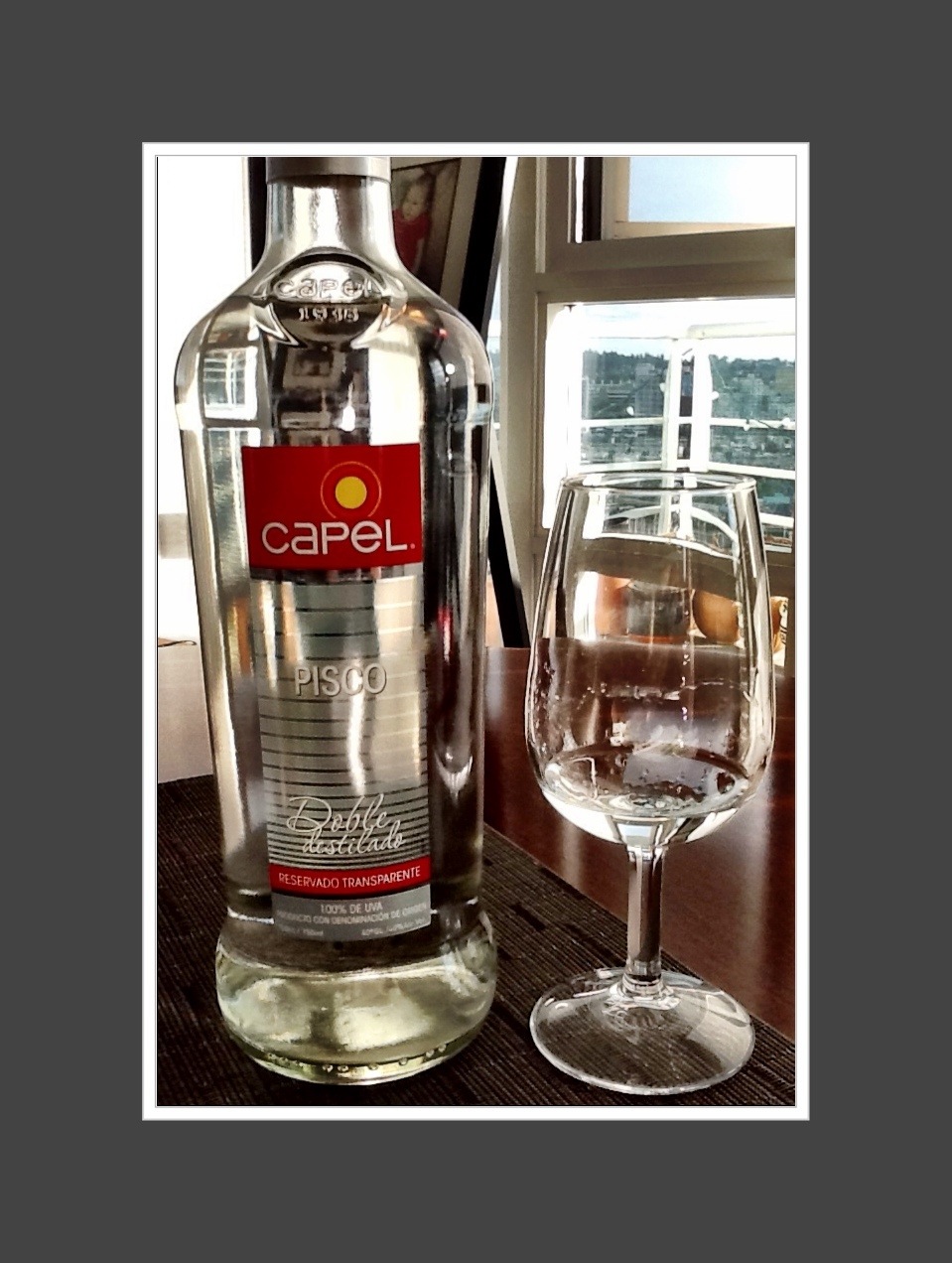
Capel, Pisco, Double Destilado, Reservado Transparente, Vallee de Elqui, Chile 40% abv

Around since the time of the Spanish explorers, Pisco is often thought of as a pommace spirit (akin to Italy’s Grappa or France’s Marc). It is, however, a brandy made from distilled grapes. It’s the national drink of both Chile and Peru where citizens argue constantly as to which country it originated in http://dinersjournal.blogs.nytimes.com/2012/07/27/the-pisco-wars/?_r=0). Since there is a port city in Peru called Pisco, I’d wager Peru is a safe bet. It’s also popular in Bolivia where it’s called Singani.

In Peru, Pisco is named according to the type of grapes used as the base material; Pisco Fur (Fur grapes), Pisco Ciuvre (Negra Corriente, for example), Pisco Aromatico (for Moscatel d’Alexandra and Torrontel) and Pisco Verde, made from partially fermented grapes.

In Chile, Pisco is made mostly in the north’s Elqui Valley – as is this example – from Moscatel d’Alexandria, Torrontel and Pedro Ximenez grapes, and the naming depends upon the amount of ageing and percentage of alcohol present. The unaged versions are 30% abv and called Seleccion, Especial refers to 35% abv and is short aged, Reservado is 40% abv and aged longer and the Gran Pisco is the most aged expression.

Ageing takes place in casks made of the native Rauli wood and the spirit is usually distilled in pot stills, is water white and colourless. It tends to have aromas of jasmine and orange blossom and is beautifully aromatic due to the varietals used which are strongly floral.

This spirit is clear and bright, water white, colourless and has legs. On the nose, it’s got pronounced intensity with aromas of orange blossom and jasmine bud, flowers, some pungent green leaf, vegetal tones and is matured (this example is Reservado).

The palate is dry with warming alcohol, medium body and pronounced intensity with flavours of orange peel, flowers, jasmine blossom, citrus, soft cooked green bell pepper, leaves and grass. The length is medium with some complexity.

This is WSET ‘good’ (the low end of ‘good’) – beautifully aromatic with simple complexity, but balanced and integrated. If either the warming alcohol or medium finish were higher, it could be ‘very good’. I can see why Peruvians and Chileans fight over the intellectual ownership of this spirit. Bring on the Pisco sours and Pineapple Pisco punch.

20130923-202854.jpg

Posted in SPIRITS | 2 Comments

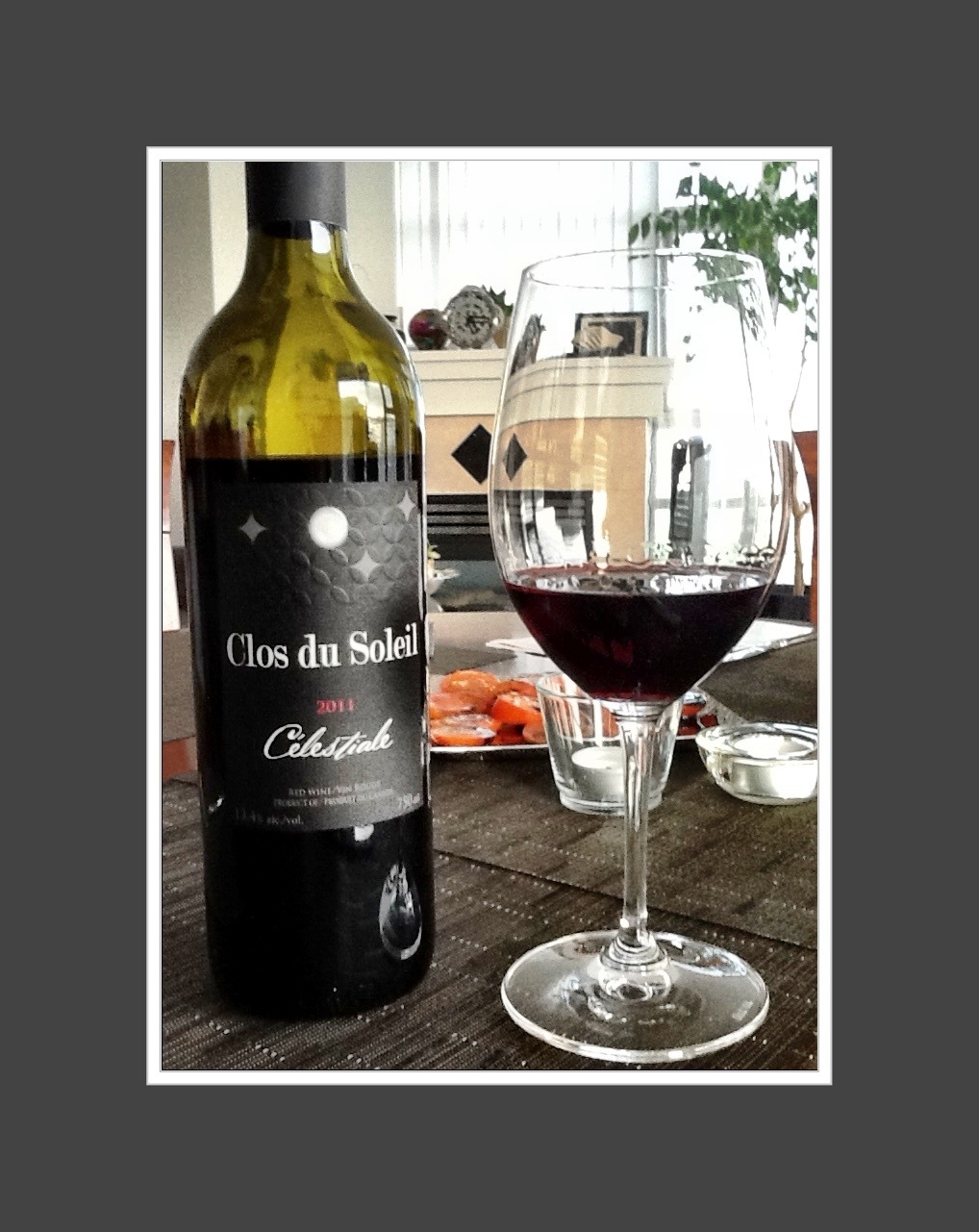
Meritage, Clos du Soleil, Celestiale, Similkameen Valley VQA, BC, 2011, 13.4% abv

I’ve been waiting patiently for the delivery of my mixed case of Clos du Soleil wines via friends who made the trip to the Okanagan last week. One of the wines in this case is the Celestiale.

The dictionary definition of ‘Celestiale’ lists ‘heavenly’ as the closest translation of the Italian word. Not is this wine only ‘of the heavens,’ but the name mirrors the penchant this winery’s owners have for following the oft complicated, but highly rewarding biodynamic philosophy.

Only 250 cases of this wine were produced at a cost of $24.90/bottle. A blend of Merlot (44%), Cabernet Sauvignon (40%), Cabernet Franc (10%), Petit Verdot (3%), and Malbec (3%), this Meritage or classic Bordeaux blend spent 18 months ageing in French oak barriques before bottling.

This wine is clear and bright, deep ruby moving to garnet with solid legs.

On the nose it’s clean with medium intense aromas of blueberries, tobacco, ripe August blackberry, spice and black pepper, a floral essence, vanilla pod and oak.

The palate is dry with medium alcohol and medium body, grainy, slightly grippy tannins streaked with green vine, medium acidity and medium plus intense flavour characteristics of mulberry, blueberry, tobacco, spice box, cedar frond, leather and blackberry vine. The finish is a strong medium plus.

WSET Very Good – It’s drinking well but can be saved for 5-7 years considering the fruit, tannin and acidity. It has a lovely, almost delicate complexity and the integration of alcohol with the flavour characteristics has been done with attention to detail. I will save my last two bottles and do comparison notes to see how it develops over time.

We paired this with barbecued mild Italian sausages, wild mushroom couscous and fresh tomatoes with basalmic and fresh cracked pepper.

20130922-171946.jpg

Posted in BC, Cabernet Franc, Cabernet Sauvignon / Blends, Malbec, Merlot, Petit Verdot | Tagged , , , , , , , , , , , , | Leave a comment

Tantalus, Chardonnay, Okanagan Valley VQA, Kelowna, BC, 2010, 14.2% abv

Purchased in February 2013 at the winery in Kelowna on a beautifully sunny late winter’s day, this wine was part of a case I was lucky to snag following the venerable Jancis Robinson’s declaration of the 2008 Tantalus Old Vines Riesling as the best white wine in Canada.

Tantalus has managed, as a result of darned hard and good work, to make quite a name for itself as a Riesling house. This wine is an example though of why they’ve become so well known for not only their Riesling, but also for other varietals including Chardonnay, far outside the boundaries of BC.

This Chardonnay wine is clear and bright, pale gold with legs. On the nose it’s clean with medium plus intense aromas of oak, significant lime, citrus, honey, wax, lemon creme and quince. There’s a sharp minerality as well to the aromas.

On the palate it’s dry with medium plus acidity, medium alcohol, medium body, and medium plus flavours of lime creme topped with lime zest, more quince, Granny Smith apples and bright starfruit. The finish is medium long and this is WSET Very Good wine.

I would love to try this in a tasting alongside one of the New Zealand Kumeu River Chardonnays; they’re both very good. We enjoyed this with a lemon peppered basa fillet alongside quinoa and long grained wild rice. Stunning on one of the final days of summer.

20130921-170657.jpg

Posted in BC, Chardonnay, WHITE | 2 Comments

Saint-Vivant, Armagnac, Condom, France, 40% abv, C$59.00

Armagnac is frequently mistaken for its cousin Cognac created about 150km north of Bordeaux. It was easy for the Dutch and English to trade in Cognac as transportation of the ‘brandewijn’ or burnt wine / brandy used to fortify wine during transportation was easy via the Charentes River.

However, further to the south, the landlocked AC of Armagnac was in a tough position and as such unable to capitalize on the slightly earthy, fuller spirit created in Gascony. What this meant was that Armagnac struggled to be noticed by the world and as time marched on, eventually the industry was hit hard by phylloxera, then prohibition and several world wars. Armagnac distillers didn’t change the Alembic Armagnacais single column still they used to produce the spirit in either – originally with about 3 plates, today’s versions have only 15-20.

This means Armagnac is fruitier, deeper and richer than the average Cognac as it’s only distilled once and with secondes (the tails of the distillation process). There are only about 18,000 hl of Armagnac being produced today – just a fraction of what is made in Cognac. But with tastes changing to deeper and richer spirits around the world, Armagnac’s fortunes look ready to rise again.

Armagnac is made from Baco 22A (a crossing of Folle Blanche and the hybrid Noah), Folle Blanche or Colombard in addition to 9 other possible white grapes in three Crus – the best being Bas Armagnac, Tenereze or the lesser Haut Armagnac.

This Armagnac is clear and bright, light amber with significant legs.

On the nose it’s clean and matured (as a VSOP it’s at least 4 years old by law, but as most are aged much longer, it’s probably between 10-15 years old). It has medium plus intense aromas of orange rind, sweet orange blossom, brown sugar and clover honey, patisserie, toffee, vanilla and caramel. Some baking spice accompanies the oak and a sandalwood perfume.

On the palate, it’s dry and has smooth alcohol with some initial heat but marvellous integration and complexity. It has medium plus body with pronounced flavour intensity similar to the nose with mandarin orange, citric zest, fig, oak, vanilla, caramel, clove and cinnamon. It has a long finish with complexity.

Beautifully balanced and with the long finish and intense flavour spectrum, it’s an outstanding spirit.

20130909-222558.jpg

Posted in Armagnac, France | 7 Comments